Sunday, December 23, 2012

Merry Christmas

Western Bluebird

Merry Christmas all!  
and may your new year be full of creativity, 
good happenings and whatever else is dear to your heart.  

I decided to paint something typical of winter in western Oregon, only I'm stretching it a little by adding the snow.  Usually we get just a hand full of snowy days in the western valleys.  We can always drive into the mountains and get more snow than any child could possibly wish for.  When our girls were teenagers our favorite way to spend Christmas day was to drive to the rim of Crater Lake and cross-country ski along the rim.  

As I type, big foofy flakes are falling.  They aren't sticking yet, but it does give a Christmassy feel to our soggy world.  

Saturday, December 15, 2012

Once Hidden


Winter comes slowly to western Oregon.  A few leaves start to turn yellow in September, others wait until October and November.  Even now, in December, sycamore leaves are a medley of of rich crimsons, reds and burnt gold.  Other trees are bare, including this maple above me.  

How many times have I walked under this nest and not seen it?  It’s two blocks from home and on my regular jaunt around the neighborhood.  This nest remained hidden until the winds stripped the maple leaves and tossed them into the rain.

*    *    *    *    *
While I was posting the above nest I got to thinking about other nests I've painted in the last couple of years.  ... Nests are always of interest, whether active or sitting empty, their job done.  If you've been reading my blog for awhile you may have seen most of these.

The snowy one was inspired in Yellowstone .... probably a robin's nest.


Double-crested cormorants nest in colonies.  This colony is near the Oregon coast.

I was searching for dragonflies just a few miles from my home when I found this mallard nest tucked in a blackberry tangle.  I wouldn't have intensionally gotten so close.  I only paused for a moment, then sketched from memory.  

House sparrows usually take over bird houses or nest in nooks and crannies of buildings.    I was surprised to fine they are very capable of building a very sturdy home for their eggs.  I found at least a dozen nests in long line of Lombardy poplars which at been planted in western Washington, an area devoid of natural trees for miles and miles.

One of my very favorites nests is a bluebird nest in an aspen which has been scarred by a bear many years ago.   Some sort of woodpecker probably dug the hole.  One year I know a flicker nested there, but several years a pair of bluebirds have taken up residence.  Unfortunately the tree was reaching the end of its life when I sketched this.  It has since fallen.  There are plenty of other holes for them to choose from.

Sunday, December 9, 2012

Peanut Butter and Toast


Black Oystercatchers have bills so bright they look as though they are made out of fire-engine  red plastic -- Nov 15, 2012
I used to wrinkled up my nose at the very thought of peanut butter on toast.  But, like Pavlov’s dogs, I’m trainable.  For those of you unfamiliar with Pavlov’s dogs, a Russian researcher named Pavlov found that a dog trained to hear a bell before he was fed, soon was salivating when he heard the bell.  My peanut butter on toast is my bell.  I call it ‘my Yellowstone breakfast.’  Whenever we head out the door early we take with us toast, hardboiled eggs, juice, coffee and maybe a turkey sausage.  Usually it means we are heading out for a day of discovery --- and those are special days. 

While I smeared peanut butter this morning I realized it had been nearly a month since we had a Yellowstone breakfast.  Finally last night I felt both projects mentioned in my last post are under control and I can return to my own life.  There will still be some loose ends to tie up, but the mother-load of work is done.  It has been so rainy we wouldn’t have gotten out much more anyway.  

So today the weatherman promised partly sunny on the coast.  We took off with cameras and sketchbook.  Never did see the sun ..... but, oh! it felt delicious to get out.  I napped most of the way to the coast and most of the way back.  It’s a two hour drive each way so that is a lot of napping!  

A bald eagle flew out onto the rocks and waits ... and watches -- Nov. 15, 2012
Peregrine -- Nov 15, 2012
Today we went to Bandon first and then on to Simpson Reef.   It happens that the last trip, nearly a month ago, was also to Simpson Reef.  Both days were mellow and grey and gave me a wonderful opportunity to sketch.


Today's notes:

I think of a favorite haiku written by Phyllis Lesher:

Pewter sea and pewter sky
Sandwich filling
Gull and I.

Only this pewter sea and pewter sky is filled by hundreds of sea lions barking and growling.  Gentle waves lap in.  The tide is way out; about to turn and come back.  

Several star fish are bright against dark rocks.  Even lower on the rocks I see long blades of aquatic vegetation exposed by this very low tide.  I don’t often see that.  

These three cormorants have been fishing.  First one and then another spreads its wings to dry, then preens a little, then dries some more.  A pair of harlequin ducks float in a shallow bay nearer to me. 


Beyond the cormorants, the sea lions jostle for space.  To top things off a bald eagle lands nearby.  We can’t see where he perched but he sings for us, the silly warble typical of adults.


Sunday, December 2, 2012

My Projects

A prairie chicken cock 'booming,' i.e. dancing his heart out to attract a lady.  

Now that our rainy season has started with a vengeance I’m supposed to have lots of time to hone my blog .... right?  --- Wrong!  My umbilical cord has become attached to my computer, but I’m helping others rather than working on my blog.  I’ve had two projects on the back burner and somehow they they both came to a head at basically the same time; and both involve my parents, Frederick and Frances Hamerstrom.  My parents were well known ornithologists who spent their career developing the management plan for prairie chickens in Wisconsin -- and are credited with saving the species in that state.  
My mother, Fran Hamerstrom with her golden eagle.  She is ready to throw her eagle into the air and call her back with a whistle and a lure.
One of my projects is the re-issue of an anthology of stories I put together after my parents’ deaths, “Hamerstrom Stories.”  Deann De La Ronde, a friend and dear woman who lived with my mother for the last two years of her life successfully twisted my arm and we collected an armful of stories about my parents written by friends of my parents.  Stories included topics such as: ‘Half a Cow is Better than None’, ‘Footed by a 7-Pound Snowy Owl’, and ‘A Hunter I Wasn’t.’ 
My father, Frederick Hamerstrom, was a much quieter person.  He was the foundation of the prairie chicken research.
"Hamerstrom Stories" was never intended for the general public.  Even so, I sold 350 copies ... at cost.  Now I’ve granted permission to the people who run the Prairie Chicken Festival in Wisconsin to reissue the book along with stories by eight new contributors.  I’m nearly done with that project.  
My Mother

The second project is another book.  Susan Tupper has had a manuscript for young readers accepted by The Wisconsin Historical Society, “Frances and Frederick Hamerstrom, Pioneers of Wildlife conservation.”  The press wants lots of photos and drawings .... and guess who has them.  I’ve been searching for photos, scanning and editing until I’m cross-eyed ... but I’m getting there.  Susan’s book is going to be a wonderful way for young people to learn about the early conservation work done by my parents.  


My Father


Aldo Leopold, mentor to my parents when they were his graduate students. 
My father got his Phd under Aldo Leoplold, “The father of Ecology;” and my mother was the only woman to get a degree under him, her masters.  

.... I just thought I'd let you, my readers, know what has been keeping me busy.

Saturday, November 17, 2012

Nor for the Faint of Heart: Part II

Note:  Be sure to read Part I before Part II
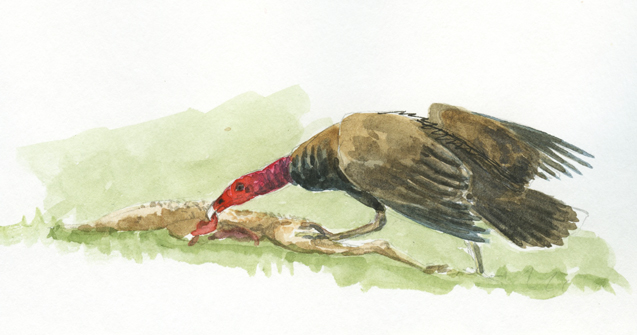
The wariness of the vultures reminds me of a day years ago when we hoped to photograph turkey vultures on a dead sheep.  We got permission from the farmer to enter his pasture.  Of course we spooked the vultures when we hiked out to the carcass.  We came prepared.  We both lay down under the cover of some camouflage netting and waited for their return. ... and waited. .... and waited.  The ground was damp.  Flies found us.  We tried not to move.  Our wait definitely didn’t qualify as a sunny nap amongst the buttercups.  Two hours later we gave up.  By the time we got our stuff back to the car, the vultures were back on the carcass.  


I get our biggest tripod and by standing on a chair can I push my camera almost to the top of the doorway -- and can photograph right over the deck railing.  Half of the vultures are soon back, five adults and one immature.  An immature is easy to tell from an adult.  Their heads are charcoal grey, whereas the adults have bright red heads with just a few black feathers.  From the looks of things it would be a good idea if half their body was naked too.  This really is quite a gory process.  
The immature bird stays close, but close enough to eat is too close.  He immediately gets chased off.  At the rate the adults are inhaling food, I suspect he’ll soon get a chance.  I switch to sketching for a while.  
After a couple of hours of watching I’m learning a lot about turkey vultures.  The vultures seem to have a definite pecking order with young birds on the bottom rung.  The older birds have a pecking order too.  Some new arrivals are immediately chased off; others fly in and take over the carcass without much fuss.  Once full, a bird flies off.  I suspect if I walked out on my deck again, I’d flush a bunch out of the tall trees above our house.  My deck roof hides my view.  
I must be a little nuts to take such an interest in these goings on.  We had planned to leave on a camping trip today, but I’m almost glad my back is bothering me and we decided to delay another day.
11.45AM  I sat down to type some more notes and now all my vultures are gone.  Don’t know what spooked them.  Last I looked I had three immatures and two adults.  The adults were pretty much keeping the immatures away.  I’m sure the youngsters didn’t have their fill.  

About 12:00 one adult came in and fed until full -- about 20 minutes.  I’ve looked several times during the past hour.  Yard empty.  I finally went outside at 1:20.  No birds in the trees either.  Plenty of meat on the fawn although they could use some assistance breaking more of the skin open ... which I didn’t do. 
Off and on during the afternoon a bird or two flew in for a snack.  Much quieter than this morning.  Late in the day I walked out to the carcass again.  The vultures have cleaned out the body cavity and most of the hind quarters.  The shoulder skin appears too tough to break into.  The good news is the fawn is now considerable lighter, probably less than half of its original weight.  Already it is getting very stinky.  We manage to stuff in into a garbage bag and slip it into our garbage can.  

Day 3
It is barely light when I watch a vulture soar low over our yard.  I feel a little guilty.  No bonanza in my yard today.  I’m also thankful.  Thanks to the vultures, our problem was reduced to a manageable size.  

*   *   *   *   *


A friend, Stan Moore, recently sent me a poem he wrote.  With his permission I’m including it here.  Its a little off subject, but since I doubt I’ll ever get to see a condor, I decided to end my vulture experience with his words.....

I saw the condor
The condor saw me
I was more impressed than he.

I asked the condor
What is eternity?
He said I should wait and see.

I died
and the condor fed on me
Our tissues commingling.

I am the condor
The condor is me
We are one eternally.


Saturday, November 10, 2012

Not for the Faint of Heart: Part I


 Note:  Time just flies by!  This event happened about six weeks ago, just before our first trip to the Klamath Basin.  I decided to keep those posts together and now it is time to type up my notes from Sept. 22 and 23, 2012.  If you’d rather not hear about turkey vultures and dead things, just skip the next two posts.  I find vultures fascinating ... and very good at their job of helping to clean up unfortunate accidents.  What happened in my own backyard was a rare opportunity for me.

Sept. 23, 2012:  An hour ago I was delighted to finally see the doe and fawns that I know have been visiting our backyard.  Mostly I just see their big poop and little poop.  About ten days ago our house guest, Jack Gilchrist, saw the doe and two fawns in the yard at first light.  Each morning since I look for them, but never see them ... until now.  
About 5 PM I spot the doe, a black-tailed deer, and one fawn checking to see if they can reach any apples.  They’ve already eaten the easy ones.  Then the two walk over to the blackberries and spook three white cabbage butterflies .... so pretty!  It takes me awhile to find the second fawn. I sense something is wrong.  It lies under my concord grapes, its sides heaving.  I even make a light remark to Dale she must be having a bad dream about being chased.  

Back to my cooking for a moment and then I look again.  A turkey vulture has landed in a nearby tree and the fawn lies still!    I doubt five minutes has elapsed.  That vulture must have known the fawn was dying!

The doe approaches her still fawn, but only to within about ten feet.  The vulture flies off.  I’m not sure if the doe spooked the vulture, or if I did.  I think the vulture spotted me looking out the window.  The doe leaves.

Half an hour later the vulture lands on the low bough again ... and fifteen minutes after that it drops to the ground and approaches the fawn.  I catch a glimpse of the other fawn peering around by blackberry clump.  The doe must be back there too.
Soon a second vultures arrives and both start pulling and tugging on vulnerable parts of the carcass.  Darkness comes soon.  One vulture stays until it is almost too dark to watch.


Day 2:  
7:20 AM:  First vulture arrives.  It barely has time to get serious about eating, when Lucy, the neighbor’s black lab, arrives.  Darn!  I don’t know why the fawn died  Lucy shouldn’t be there.  I quickly shoo her home and telephone her owner.  They’ll keep her home.  

Next I telephone the Public Works Department to see if the city will remove the fawn.  They have two suggestions: Either have a neighbor with a pickup take the fawn to the dump or drag it to the street and they’ll pick it up sometime next week.  The dump won’t be open for three days and I really don’t think to dumping it in the street is a solution.  I live in a residential area.  

I ponder on the problem.  Years ago Dale and I would  have just thrown a tarp in the van and hauled the fawn off to some isolated spot ... but right now neither of us are up to lifting it.  Even the vultures are gone since Lucy spooked them an hour ago.  .... No they aren’t!  I step outside to take a look and spook several vultures out of our trees.  

9:50 AM  I look out my kitchen window again.  Nine turkey vultures, no 10,  no 11...12.  One is on the shed, two on the fence, I can hear one shift his feet on the deck roof above me, one flies past, but most are on the ground next to the fawn.  Maybe we won’t have to worry about having someone come to remove the fawn.  The vultures are going to do it for us.  
I have to admit it is fascinating watching ... but not for the faint of heart.  Last night the birds had worked on every orifice and broke open a little skin on its belly.  Now significant progress has been made opening the carcass.  It is easy to see why turkey vultures have naked heads.  One reaches right into the body cavity, pulls and tugs.  Another waits for an opportunity.  Two more are working on the head.  

Suddenly I get a bright idea.  I’m in my dining room, peering at the vultures through my deck railing ... wishing I could get a clean shot at the birds to photograph them.  I crack open my sliding door open, wide enough for my camera lens.  Darn!  Just doing that flushes all the birds.  But I bet they’ll come back.


Friday, November 2, 2012

Fire!

Lava Beds National Monument:  October 12, 2012
 On our most recent trip to the Klamath Basin we sorta expected to stay three nights.  We pulled out of our Lava Beds National Monument campsite on Thursday morning and headed toward Tulelake NWF, planning to spend the morning there and then home via Crater Lake.  But the morning was good to us; temperatures were pleasantly cool after unseasonable warmth.  We just weren’t ready to head home.  We decided to spend one more night in the Basin.  

During the afternoon I noticed a dark plume of smoke rising to the south.  We didn’t think much of it.  Some of the fields around here are burned after harvesting.  We dismissed it as one of those.  I was dense!  Two odd planes flew over with red painted on their tails.  I thought the nearby military base was practicing with some old planes.  Dense!   


But as we head back to camp we begin to worry.  The fire looks close, too close.  It appears to be on Lava Beds National Monument land.  They wouldn’t be doing any prescribed burns under these extremely dry conditions.  We pause at two pullouts and watch the fire.  It is nearly 8 PM when we pull in to the Visitor Center.  The building is dark.  That’s a good sign. 

Off to the east one usually sees  twenty miles darkness and finally a strip of far off ranch lights twinkling in the distance.  This fire  burns much closer than that.  I can see individual trees silhouetted against the flames and flames jumping far higher than the trees into the sky.  Headlights too.  

We head down the hill to the campground with a heavy heart.  How close is that fire?  What will it do during the night?  A few years ago we got side-tracked by a wildfire about 100 miles north of here.  We had planned the spend the night in Bend, Oregon, with friends.  By the time we neared their house, a wildfire had broken out on their side of town.  Their road had been cordoned off and only residents could enter.  We parked on a hill for a couple of hours hoping the fire would die down and we be allowed to go through.  No such luck.  
The Bend fire, painted from memory and from an old sketch in my journal.
We watched one lodgepole after another ‘candle,’ i.e. burst into a column of flame.  Half the sky sparkled clear and the other half was smothered in smoke.  By the time we gave up getting to our friend’s house every motel in Bend, Redmond, Prineville and Sisters had been taken.  We decided to sleep in our car in the Sisters city park.  During the night one convoy after another of firefighters rolled in for one last rest stop before reaching the fire.  By morning the fire had traveled six miles during the night and burned a handful of homes.  Usually fires grow fastest during the day, but they can gallop at night too.

As a U. S. Forest Service employee Dale has had first hand experience with forest fires -- all the experience he wants.  We look at the ugly glow off in the distance and decide to head home and not take any chances.  First I want to eat before the four hour drive.  We hang two candle lanterns in the van and start eating our cold supper.  

While we eat a truck parks near us.   A park law enforcement official walks over .... a cute young woman.  She assures us two people will be up in Lava Beds fire tower all night monitoring the fire.  It is unlikely the wind will turn against us, but if it does the park will be able to give us at least an hour of notice to evacuate.  The fire is five miles away right along the park’s eastern boundary.  

The fire was started by a hunter’s all -terrain-vehicle just outside the park around midday.  Six smoke jumpers are already on the fire and some fire fighting equipment.  Smoke retardant is planned in the morning.

By morning there is hardly any sign of the fire.  Just wisps of smoke drifting up.  We stay in the Basin until noon.  No smoke visible.  I didn’t see any air planes so I don’t think they needed the fire retardant.  

In the grand order of things, this was just a little fire.  Western United States has had some huge ones this summer.  Hundreds of homes and many thousands of acres burned.  Some of the fires will burn until the winter rains come.  The next night, when we arrive home, sprinkles of rain greet us.  First rain since about July 1.  Most welcome!