Friday, July 12, 2013

Move Along: An Eastern Oregon Cattle Drive


Late May.  Dale and I are spending the morning a few miles south of Burns, Oregon.  Grey clouds hang over this vast expanse of flat valley.  We’re parked on the side of a long, straight gravel road that passes miles and miles of green pasture and shallow wetlands.  It is wide open country, hardly a tree to be seen.  The horizon line is interrupted by a far off ranch and a few shade trees.  Farther off, slightly higher areas go into sage.  Many miles away we see snow on the Steens Mountains.

Dale and I have been listening to willets, curlews and snipe court and call in the early morning sky;  red-winged blackbirds and yellow-headed blackbirds sing from nearby gnarly fence posts and cattails; barn swallows zip over the shallow ditch, foraging for insects.  So much for us to watch, sketch and photograph.  

Way down the road, blurred by ‘the vapors’, a see a dark mass moving towards us.  We call heat waves ‘the vapors’ because they have so little to do with it being hot.   It was close to freezing earlier in the morning and the breeze still gives a cold bite to the air.  Moisture seems to cause the vapors as much as heat does. 

Slowly the motion far down the road separates into four cowboys on horseback, six dogs, and over 100 black cows, one cream cow, a couple of rusty cows plus their calves.  The cowboys are dressed for a chilly ride:  thick jackets, chaps, warm hats --  three men and one woman. They slowly move the herd towards us.
At first I keep looking for birds, then I realize it is the herd I should be watching.  With the help of the dogs, the four cowboys just mosey the herd along. The mellow lowing of cattle mixes with a sky full of bird calls.  About a quarter of a mile ahead the lead cowboy opens a gate into a large pasture.  The pasture looks to be a mile square.  With the assistance of the dogs, every cow and calf turns into the pasture.
Once inside the pasture, the herd is still kept together and nudged well into the large field.  Any cow that moves off is quickly brought back.  It just takes a short command and two of the Australian shepherds spring into action chase a stay back.  Another command, and the two dogs drop in their tracks and wait.  
Now three dogs run along the edge of the herd, tightening up that edge.  On command they drop into the grass, waiting for their next job.  The cowboy’s job seems to be a steadying influence and to give orders.  The dogs do the scurrying.
The cowboys spread out, one of each side of the herd.  One cowboy in particular is frequently going in tight circles on his horse.  I’m puzzled.  Is the horse miss-behaving?  Is the cowboy training him?  The other three riders sit quietly.  


We watch for twenty minutes.  Are they waiting for trucks to arrive?  

Finally the cowboys leave the herd and release the dogs from their patient waiting.  While the cowboys head back to the gate, the dogs race about, full of delight.  Australian sheep dogs are a joy to watch;  eager to run; eager to obey; eager to work;  full of nervous energy.  

We intercept the cowboys when they reach the road. Craig is in charge.  Yes, the maneuvers with his horse were part training and part keeping the horse under control.  His horse is young, “Full of go, and not enough ‘Whoa’.”  One of the dogs is a youngster too.  

The main reason for keeping the herd gathered is to make sure all calves and their Mamas got together.  If they are just dumped into the pasture, any that are separated will concentrate on getting back to where they came from.  This way they have a chance to pair up and settle into their new home.  

By the time the cowboys head back down that long gravel road, several calves are nursing and many of the cows graze.  An hour later, the cows and calves are scattered over a large portion of the pasture.  One little black calf spots some black-necked stilts and tries to chase them.  Off he gallops in their direction, only to see the little birds fly up out of reach.  

Thursday, July 4, 2013

A Tale of Stolen Internet Images


This blog post will be totally off my usual type of subject, but perhaps an eye-opener for those of you who are posting anything on the internet.  Brace yourself for what follows.  I think you’ll be surprised ... and worried.

A friend of mine, Joe Conrad, sent me a link to blog posting by Ian Plant in his “Dreamscapes” blog.  The article points out how frequently photographs are now ‘borrowed‘ on the internet and may be used in ways the original photographer never intended.  This new digital era has made ‘borrowing / stealing’ just that much easier in spite of very clear copyright regulations that protect the rights of the person who created the photograph / art / writing.  

Having my work lifted is not new to me.  Before the digital era my art ended up on a matchbook cover, menu, T-shirts, embellishing a catalogue, a letterhead ... and who knows where else!  Recently a nature center scanned one of my drawings and decorated a trailer used for recycling!  I was not asked for permission on any of these usages.  But digital has made it ever so much easier.  I knew images are sometimes harvested off web sites, but I didn’t realize what a common occurrence it is ... or how often I have been a victim.

Ian’s article showed me how easy it is to do a quick check to see if my images are being used without my permission.  Just go to Google images and click on the “Search my Image” camera icon (that is the little camera on the right side of the box where you usually type in your search term), upload your image, and hit the search button. 

Ouch!  I searched for the baby robins I drew several years ago.  Prior to today I never uploaded this drawing onto the internet .... but I did grant permission to Washington State’s Fish and Wildlife Service to use the image on their site -- probably in 2005. I picked this image because a friend once stumbled across it on the internet.   I can’t be sure Washington’s site is where the digital trail started, but I suspect so.  Another possibility is someone could have scanned the drawing from one of my notecards.  

Here are most of the places I found my robin drawing:
  1. The state of Washington’s Fish and Wildlife Web site (the only place where I granted permission)
  2. The Sate of Maine’s Fish and Wildlife site -- at least they gave me credit.
  3. the social networking site “Tumbler”  ... Yetch -- some teenage girl with her bright red lips pursed to kiss had it on her site.  Other tumbler entries too by I skipped over them.
  4. a blog with mostly weird photographs such as a staged image of bald patient on an IV.
  5. an online magazine where my robins accompanied an article, “Does Your Personality Change Depending on the Language You Speak”  -- I ask, “What is the relevance???”
  6. on a web site written in Persian!  It might be a site posting poetry but I can’t be sure  -- Persian is a little beyond me.
  7. a web site selling a lot of scrapbooking stuff including rubber stamps.  I didn’t find my image on their site, but I suspect they used it at one time.
  8. a tatoo site!  I think you are supposed to download my image and take it to your tatoo artist.

 About now my computer offered me a place to click to go somewhere I definitely didn’t want to go to learn about stuff that smelled of porn.  I thought to myself .... “Time to get out of here!”  But my computer wouldn’t let me get off the internet!  I had to force quit! 

Once out, I thought I was clear, but no.  I went back to Ian’s site link and found the unwanted site was popping up again.    I force quit again and shut my computer off.  I honestly don’t think this is a problem with Ian’s site -- I think somehow the unwanted site could still reach out and grab me.  Once I turned my computer back on and went to his site via a different route I didn’t have a problem.  

So my advice is .... if you want to search to see if your images have been used elsewhere, do be careful what sites you click on.  

For now I’ll keep on posting.  I always reduce my images to a small file size before posting.  My rule of thumb is 800 pixels on the longest side.  The image is still good for the internet, but not for publication.  Also on really nice art or photographs I need to put my name and copyright right on the image.  My name was on the robin drawing, but most places I found it no longer had my name on it.  Unfortunately it isn’t that difficult to remove the name off a photograph or drawing.  

I use Photoshop elements to resize my photos and add my name.  Does anyone know of a free program that can perform both these functions for others who might be interested?

Wednesday, July 3, 2013

Watching White Pelicans

Malheur Basin, Oregon:  May 25, 2013

Have you ever watched white pelicans soaring?  Way high, in a clear blue sky?  It is worth a long pause, more than just a quick look just to verify the white flecks are pelicans.  
We’re somewhere along Ruh-red Road in the Malheur Basin.  Off in the distance, through shimmers of heat waves, a wobbly line of white is out of place in the vast expanse of the Basin.  Elsewhere on the valley floor I see a little water, lots of greens and golds, even an empty house which is literally leaning at a 45 degree angle.  If I could see farther I’d see a few more houses, most still occupied, cattle, antelope, thousands of birds and miles of refuge.  Right here stretches a grey gravel road.  A line of dust racing along the road says a rancher is about his business.  Birders drive slowly out here.  

Near me cliff swallows zoom and zip and a double-crested cormorant hurries by.  Earlier this morning the air was filled with sounds of willets, blackbirds, terns, gulls and swallows.  Now I hear the wind and a few far off terns.  My current world is busy with white pelicans.  
Earlier in the morning pelicans flew low and on a mission.  There was a steady flow of traffic to and from their distant colony.  The colony is still white with birds but morning feeding missions must be over.  At least a hundred pelicans soar high above me, sparkling flashes of white, even whiter than the few cotton ball clouds.  It is as if someone slowly stirred a great bowlful of clear blue air and sprinkled in slow moving white petals.  
The pelicans soar effortlessly in great circling clusters.  Some groups are small  -- a half dozen;  others have 20 or more.  A few gulls are with them.  They look like tiny out-of-place specks next to the broad wingspan of the pelicans.   The pelicans take advantage of a little heat rising from the valley floor.  They become a slow moving motion machine.  Those farthest off disappear when they angle towards or away from me, barely show when they are backlit, and sparkle white when the sun hits their back.  So as the flock gradually shifts position in their slow-mo circles, their brightness shifts with them.  

I have to think it would be exhilarating to be a pelican slowly soaring above the Malheur Basin.

Tuesday, June 25, 2013

Dinner With Owls

Page Springs, Malheur Basin, Oregon:  May 25, 2013
While we were out on Ruh-red Road a couple of birders told us about a long-eared owl nesting in the rocks at Page Springs Campground.  It seemed too good to be true, but we still drove the extra 35 miles south to Page Springs, 60 miles south of Burns.  
It was too good to be true, but we aren’t disappointed.  Two great horned owls are spending the day on the basalt cliff that borders the campground.  One sits in a rocky alcove half way up the face of the cliff.  Sleepy fellow.  Beautiful.  He is relaxed and close enough I can almost feel his delicate feathering.  I’ve nuzzled a full grown great horned owl often enough to know how soft those feathers are.  There is a surprising amount of air between the outer smoothness of the feathers, and the hidden warmth underneath.  Owls like their head gently rubbed.  I suppose it is an area difficult for an owl to scratch with great finesse.  
It took me awhile to find the second owl.  I end up asking for help from a birder.  No wonder.  The owl was pressed into a crevice.  Only about half an owl shows, just part of his back and often the back of his head -- sometimes a sleepy face.  I switch my attention back to the first owl and start drawing.  
Somewhere along the way the registered campers for the site I am standing in have returned.  Fortunately they are happy to share their owl and soon I am chatting as much as drawing.  Very nice couple -- Jan and Rodger.
I look up from my sketching and my owl is gulping a little; but I am too late.  The owl has just coughed up a pellet! .... and I missed it!  Big, dark and shiny pellet.  The new pellet lies on the rocky shelf at the owl’s feet. 
While the sun drops lower I realize there is a chance the owl will soon be basking in late afternoon sun.  Right now the overhang above him keeps him in shade.  But Mr. owl is in no mood for a sun bath.  Just as the sun reaches him he moves about four feet into a shadier spot.  The crevice owl is still safely out of the sun.  
By now Jan an Roger have invited us for supper!  Jan disappears into her camper for awhile and comes out with a wonderful meal:  fresh salsa, browned hamburger and pinto beans on a bed of lettuce, warm tortillas, fresh oranges and mangoes.  Yum!
Just before we sit down to eat the owl comes out into the forward edge of its ledge.  For a few minutes the dropping sun glows on his soft feathers.  


While we eat we can keep an eye on the owls.  The sun slips lower, putting all of the rock face into shade.  First one owl stretches and then the other.  The owl on the shelf is in a better position for twisting and turning.  He preens, he stretches again.  He doses, but he spends more and more time awake.  Wonderful to be so close to a pair of wild owls, ones who live close enough to the campground to be people-tolerant.   

While we eat dusk deepens.  Time for robins to sing.  Off in the distance I hear a poorwill call.  
Big hoot!  The owl I sketched hooted, then off he flies.  His evening of hunting has started.  Too dark to see if the second owl is still in his crevice or has left to hunt too.  


Friday, June 21, 2013

Malheur Basin, Oregon, USA

A willet perches on a fence post.  He looks so plain, but when he flies up, calling over and over, his wings have flashy back and white bands.  When he lands he shows them off for just a moment more, before going back to his quiet pose.

When we come home from traveling I have a journal full of ideas for blog posts .... and am arriving here during our busy season here.  So most of them never happen.  Year after year Malheur gets short changed, and yet it is often a special stop on our way home.  This year I plan a series of at least three posts inspired by the Malheur Basin.  

Malheur Basin is a huge, very flat basin in Central Oregon.  It’s flatness stretches roughly 30 miles east and west and even deeper north and south.  Some areas are edged with volcanic rimrock; other areas fade off into the distant mountains.  Sometimes the basin contains a fair amount of water, but normally it is a mix of some water, wetlands, pasture and sage.  It’s a nursery for thousands of birds set in the middle of Oregon’s high desert.  the basin’s vastness and the wild variety of birds makes my heart sing.  It is also a welcome change from all the people who are piling into Yellowstone by the time we leave there.  Here there is just a handful of ranchers and a few bird watchers.  
May 23, 2013:  From my notes.......
“The moon looks full, but it already rides high in the sky and yet it is not yet dark night.  The full moon must be tomorrow or the next day.  Soon in any case.  A few minutes ago, when I painted the moon, blues and a touch of crimson colored clear parts of the sky.  Dark clouds tried to hide my moon.  Now the clouds have mostly moved on and the moon shines with a hazy glow.  It’ll be cold tonight -- probably a frost.  A meadowlark sings off in the distance.  One frog sings in spite of the chill and I hear a Wilson’s snipe calling.  A little earlier gulls and ibises flew to their roosting spots.  I half expect a straggler to come winging by before I go in.  Dusk is coming quickly.  By tomorrow night I should have seen curlews and    willets courting, perhaps grebes dancing, yellow-headed blackbirds singing their scratchy song, and ibis flying overhead.  I’ll for sure soak in marsh sounds and smells.”  
This year we spent three full days in the basin.  We probably would have stayed longer if the weather had been more cooperative.  Sometimes heat makes it miserable in the basin; this year the weather changed to cool and frequent showers.  Napping in the car for an hour or two while a shower passes through is wonderful, but not for a day or two!

By the end of the first day we have seen over fifty species of birds.  True birders would have seen over 75, but we tend to stay in each spot too long and don’t get a long list.  The Malheur National Wildlife Refuge is a birder’s paradise in late May because a variety of unusual birds are attracted to the few oases of green out in the high desert.  

More sketches ....

The raven has stolen a good-sized egg, possibly a teal's.  Another raven is being mobbed by blackbirds because  he got too close to a blackbird nest.  The female Brewer's blackbird just after copulation.


Saturday, June 15, 2013

Sketching Dragonflies

Douglas County, Oregon, USA

Earlier this spring I told myself I don’t need to sit and drip in the hot sun;  shading my camera so it doesn’t fry; squinting because my paper is too bright in the sunshine ..... I should be nicer to myself than that.   But, then I find a dragonfly that has just emerged from its exuvia (nymph casing) and hasn’t even opened its wings yet.  

I fetch a 3 inch cushion and plop it on the damp ground.  I’m sitting just a few feet from the edge of a pond.  There is only about ten feet of shoreline open to the pond.  Lots of cattails on either side.  This tiny, sun-warmed bay is a mecca for dragonflies.  Last year there never seemed to be a normal quota.  This year lots.

I’ve just settled and I spot a pair of cardinal meadowhawks (dragonflies) flying in tandem.  The bright red male hangs on to the back of the female’s head with his cerci.  She frequently dips her abdomen just to the water’s surface -- laying eggs.  
Song Sparrow
Soon insanity strikes.  I decide to quick sketch every dragonfly species I see from this one spot.  It’s hot.  Dragonflies love hot.  I drip and get sticky, but I persist.  A fly buzzes by.  A song sparrow discovers me and scolds.  Way off I hear a pileated woodpecker pounding.  Zip!  Zoom!  Many of the male dragonflies are very territorial.  Chases go on right over my head.  

Finally it’s time for lunch.  I’ve got six species of dragonflies, a damselfly, and I couldn’t resist adding the little crab spider hunting from the top of a cattail.  I’ve sketched a couple of chalk-fronted corporals, the pair of cardinal meadowhawks, a widow skimmer, an eight-spotted skimmer, a four-spotted skimmer, a female western pondhawk,  plus two damselflies and the crab spider.
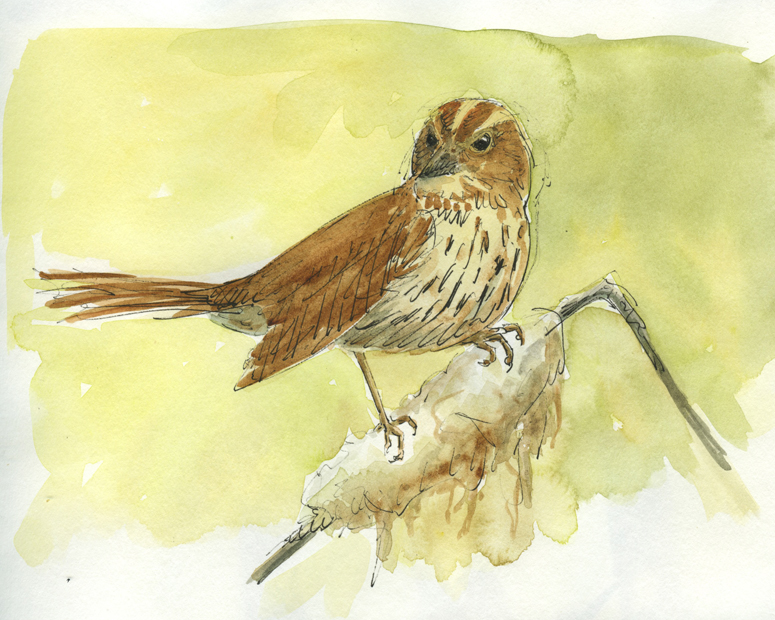
Shadows have grown long putting the far side of the pond in shadow.  A song sparrow pops up into the late afternoon sunshine and sings a brief soliloquy.


Saturday, June 8, 2013

Newts and Spiders


Now doesn’t that sound like something for a witch’s brew? ... something I should save for Halloween?  Halloween is a long way off and right now is the time to see these two things.  

I’ve been watching and sketching rough-skinned newts,Taricha granulosa, at a little reservoir about twenty miles from my home.   From my Journal:

“A few Ods (Odonata - dragonflies and damselflies) are  flying.  A 4 PM half the pond is in shadow.  Dale found a hot spot for newts.  I sat down quietly with my sketchbook and waited for them to relax.  He saw at least 8 within my immediate viewing, all in the water, but at first I don’t see any.  Soon a gnarly head peeks out from between underwater rocks ... and another.  A third drifts slowly up and parks itself just beneath some floating pond weeds -- hunting?  Over to my right two more swim to the surface for a quick gulp of air.  One sinks back down immediately; the other hangs suspended between the surface and the pond floor three feet below.  I marvel at how he can choose where to suspend himself.”

Rough skinned-newts are wonderful fun to draw.  Much of the year they live on land, but now many are in the pond mating and egg laying.  They live in slow motion, and since they often come up near the water’s surface, I can get a good look.  It took me awhile to verify each has four toes in front and 5 toes behind.  Their tail is used for swimming.  When one wants to go somewhere, it tucks all four leg next to its body and just wiggles its tail in a fluid motion.  The male's tail reminds me of a long, long tadpole tail -- flattened vertically.  The Female's is rounder.

Rough-skinned newts have the deadliest natural toxin yet discovered, far deadlier than potassium cyanide.  Pufferfish and blue-ringed octopuses have the same poison, tetrodotoxin.  Fortunately the newts aren’t out to get me.  Their toxin is a defense.  As long as I don’t eat one, or inject their poison I’m safe.  But I should wash my hands if I handle one.  
While eating lunch I suddenly realized this spider was about 5 feet from me.  It had ‘sewn’ two leaves together to make a little shelter.  Little bits of last night’s cobweb, an orb, still slung to one of its leaves.  She (?) looked very cozy in her hidy hole.  Puddles in the area told me it had rained recently.  I suspect she stayed dry.