Saturday, July 31, 2010

Helping a Wasp

Yellowstone National Park: May 14, 2010

Blacktail Loop Road – a dirt road closed to cars at this time of year, but open to hiking.

Blacktail Loop Road is a blackboard waiting to be read. We hiked in a few days ago and found both wolf and grizzly tracks. The next day it was obvious a wolf had come through again, and a coyote. Today the wolf and grizzly tracks are fading, but I noticed small black wasps, and to my mind comes “spider hunting wasps.” Sure enough. Before long I spot a wasp crossing the dirt road, burdened with an immobilized spider. He crosses the road and I thought lost his spider. The spider got caught up in a one inch tall tangle of vegetation on the edge of the road. The wasp seems to be searching everywhere. I decide to help out – I nudge his spider off the little plant and onto the ground where he can find it. Ha! He came right back and put the spider back on the plant – “Silly woman. Leave my spider alone!” He goes back to searching.

I finally realized he is looking for a place to dig a hole and deposit his spider. Spider hunting wasps immobilize a spider, deposit the spider in a tunnel of their own making, lay an egg on the spider, and close up the tunnel. I must have watched for twenty minutes before I gave up on seeing the end of the story. He searched, napped, disappeared, tried digging in a couple of spots and maybe he just gave up. … or is he off napping again?

But only about fifty feet farther down the road I find another wasp busy starting a hole, and a few feet farther along another hole. Both of these wasp tunnels are dug in indentations made by a bison’s hoof. I think the steep wall of the track provides a damp wall to dig into.

I decide to watch the second hole. Every few seconds fresh dirt is being thrown out. I finally get to see the wasp. It looked like the same species. Suddenly he moves about a foot away and grabs an immobilized spider he has waiting. Getting it down into the hole is a tight fit. Five minutes later he is still trying to wedge his spider down the hole … and we have a dinner date need to get back to town.

Thursday, July 29, 2010

Life or Death?

Yellowstone National Park, May 14, 2010

The water is nearly still on Blacktail Ponds. Red-winged blackbirds sing and several ducks are courting. While we are parking, a herd of about 100 bison cows and calves head upslope from the open valley, cross road to our left and continue upslope into the lodgepoles. The calves are full of bounce. They run in circles and crazy loops as fast as their stocky legs will carry them. Round and round their mamas. The mamas are steady in their pace.

By the time we park another herd at the eastern end of the pond is heading upslope too. Bison move a lot. Grazing in new areas is gentle on their range.

Suddenly both herds switch directions and come thundering back. It is exhilarating. Hooves pound and bovine grunts fills the air. Tails high, the bison stream down the steep slopes both to the left and the right of us. The parking pull-out has an even steeper slope and is a safe oasis between the two groups.

Once the herds reach the valley floor, the herd to our right tightens and turns left in order to push through the narrow space between the pond and the toe of the slope beneath the parking pull-out. One cow gets pushed too far to the outer edge and takes a flying leap over a narrow bay, a thin loop of one of the connecting ponds.

Splat! Her front feet made it across the water, but not her body. In she slips, into the pool that often drowns elk and bison when they break through the ice. But there is no ice today, just water.

We immediately realize she is in organic soup, not water . She is a couple of feet from shoreline, yet only her head and shoulders are above the pool surface. For awhile she struggles in the glop without any progress. Finally she inches to the bank. A brief rest while she puts her head on the grassy edge. Still no footing.


Most of the herd galloped beyond the ponds, but two cows pause and look back. The smaller walks down to the shoreline and touches noses with the one in the pond. The second, a large cow, snorts repeatedly and stands off at a distance. Time passes ever so slowly. We have no confidence this will have a good outcome.

Four other bison approach from the east, but the two on shore take offence and push them away. After about half an hour of waiting, the two companions walk off to join the herd far down the valley.


The poor bison in the pond tries one shoreline edge after another. She leaves a long, brown, trail of stirred up organic matter as she struggles her way along the pond edge. Over to the left edge…. … more struggling …. back to the right side. About an hour has passed. She succeeds in pushing into a narrow slot. Her head barely shows between the two grass edges. Clumps of the sod break free, but still no safe footing. Turning around looks impossible, but somehow she turns, her muzzle barely above the surface. I think to myself, “Maybe a quick end would be a kindness. She could struggle for hours before dying.”

Back out into the glop she struggles and slowly makes her way across this pond, towards a larger one. She has tested virtually every soggy foot of impossible edge of the nearest pond and two bays. But now she appears to be on a mission, slowly swimming to the opening that leads to the next pond. Dale and I are mentally willing her to continue in that direction, to where we have been hoping she’d go. It takes several minutes cross the near pond and into the next, but she now swims in water, not organic soup, and in a direct line to one of the few spots along the far shoreline where ground eases into the water. Two pairs of Canada geese and a couple of ducks are rattled as this big beast slowly swims past.


The spot she swims to is a soggy mess too, but there is hope. She finds footing and slowly gets more than her head and shoulders out of the water. Sloppy mud. Difficult footing. Still a struggle, but gradual progress. She rests half in and half out. Finally a front foot is on reasonable firm ground and she starts to pull herself out of the mud. It is not easy, but she perseveres.

By now the pull-out is crammed with eight cars and more are stopped on the road. A collective cheer go up and a huge sense of relief. She is out!

I thought she’d be exhausted. She struggled for one hour and 25 minutes, but she heads towards her herd about half a mile away. She even breaks into a trot, hurrying to catch up. Once among her herd she receives a royal welcome. Some sniff the mud on her and some get into friendly head butting. They seem as happy to see her as we are to see her safe.

Saturday, July 24, 2010

Fairy Princess - American Appollo

Diamond Lake, Douglas County, Oregon, July 22, 2010


Earlier this week I read about mouse birds on www.mainlymongoose.blogspot.com (Post: “Avian chimera?”). I thought to myself, “How has something so fascinating passed me by?” On Thursday I happened on a natural event that surprised me just as much … and it was on my own turf.

Have you ever heard of a chastity belt, supposedly invented in the middle ages to prevent sexual encounters? On Thursday I found out, much to my surprise, that such a thing exists amongst a certain butterfly. But I’m jumping ahead. I’ll start from the beginning.

It is midday at Diamond Lake, high in the Oregon Cascades. I am sitting in the car resting a sore ankle. On Tuesday I slipped down a muddy embankment and soaked a good chunk of me in Ben Irving Reservoir … but I did save the camera. I was stalking a dragonfly and didn’t see the narrow channel cut into the grassy embankment. On my way down into the mud, I twisted around and succeeded in placing my camera on the grass. Twisted. Not a good idea. I can walk on it, but it aches after awhile. But I digress ….

I’m sitting in the car and Dale is chasing an elusive snaketail dragonfly. A fairly large butterfly floats past me and lands on a nearby yarrow. That is when I realize there are three white butterflies on the yarrow, and the butterflies aren’t the slightly smaller pine white we so commonly see in the forest.


What are they doing? All three are hanging close together and two seem to be very busy. I grab my camera and sit next to the plant without disturbing them. My knee makes a handy monopod.

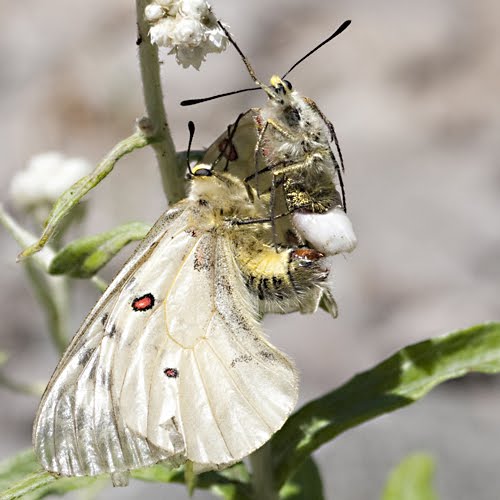
I don’t ever remember seeing this species of butterfly before, but I could easily have passed them off as pine whites from a distance. These are lovely! Their wings are semi translucent and sport delicate darks lines along with dark rimmed red spots. The wings remind me of something a fairy princess might wear. Silky hairs add to the ethereal look.


But what are they doing? One seems to have the lower part of its abdomen covered in a moist white substance, and the other has a reddish tip on the abdomen. The third butterfly wants to be part of the action, but there really isn’t room for a threesome. One leaves. I shoot frame after frame until the other two fly off, one chasing the other. They spiral higher and higher into the summer sky.

Back home I find I was watching the American Apollo butterfly, Parnassius clodius. There are three Parnassians in the United States, and they are members of the swallowtail family. The male lays the waxy white stuff, known as a spragis, onto his mated female so that she can’t mate with other males. The spragis contains his sperm and some nutrients. From the photos I can see I had two males and one female on the yarrow.

Sunday, July 18, 2010

Bison Musings and Moose

Yellowstone National Park: May 7, 2010

Crispy and crunchy. Morning sun on frost crystals brightens the fresh snow. I’m being sprinkled with fairy dust; the frost that accumulated on the branches above me is now knocked free by the gentlest air movement and floats around me. If this was January we’d be thinking, “What a lovely day!” but it is May 7th. Where are the aspen buds unfurling and spring phlox?

A big bison bull comes plodding along, also well frosted. He pauses next to a slender Douglas fir to rub some of his shedding hair off. “Ahhhh,” he rubs his shoulder hard. “That feels so good! “ Rubbing brings down an avalanche of snow from boughs above. Now he sports gobs of snow along with the frost.


A moose! First of this trip. As we were nearing the Petrified tree turnoff Dale spotted a bull moose ambling through the snow. Big Guy. Still in winter coat and with velvet antlers. His long legs reach easily over the many downed logs left after the fires of 1988. He eats a mouthful of snow off a log before ambling on.

I get out of the car and Dale drives ahead. The moose continues at his own pace until a second person gets out of his car and jogs to get closer to the moose. The moose picks up his pace and crosses the road right where Dale parked. Dale shoots from the car, getting full frame head shots! But we do wish the other guy hadn’t been so pushy.

I spent most of the afternoon drawing bison:


After kicking up their heels and running in mad circles, the bison calves are worn out, ironed flat out in the afternoon sunshine. The warmth must feel wonderful after the days of cold. Forty degrees and out of the wind looks well appreciated. The snow that covered the valley this morning has melted off. The wind is blowing again, but the herd rests in a sheltered swale. A coyote hunts ground squirrels at the edge of the swale. We often see coyotes hanging around bison herds during calving season. Bison afterbirth is an easy meal.

One cow stands and nudges her calf onto its feet. It is one of the youngest calves. We can tell because its umbilical cord hasn’t broken off yet. I wonder if she wants to make sure the little fella gets a good drink before the herd moves on.


Not long afterwards there is a general waking up amongst the rest of the heard, accompanied by a lot of soft bison grunting. The eleven calves are getting sorted out, back with their own Mamas. Soon most are nursing.

Thursday, July 15, 2010

Mama griz and COY

Yellowstone National Park: May 5, 2010

I hope it is not too confusing for you, my readers, when I mix Yellowstone posts in with current posts. I'm back to Yellowstone now.

Grayness has taken over – farther west it appears to have started snowing. We’re heading in early. As we approach Rosie’s Woods I see a grizzly on the right, just close enough to consider photographing.

I’m so glad we paused. There is a tiny cub with her, a COY (Cub of the Year). The little guy has a light muzzle and a very light collar (collar of fur, not a researcher’s collar).

Mama and cub amble across the narrow valley, climbing over one boulder and around others. When she reaches the toe of the talus slope on Junction Butte she paws the ground, obviously finding something to eat. Soon she heads up the talus slope with the little cub right on her heels. When she pauses, the cub gets underneath and peers between her legs. This Mama has a thick full coat. She would be just out of hibernation and hasn’t started shedding yet. Her cub looks tiny next to her He is covered with dark brown wooly fur. She is very gentle, carefully lifting her foot when disentangling herself from him.


Mama hikes with the little fella, zig-zagging up the talus slope and then foraging again as soon as she reaches the grassy zone. After forty minutes the cub seems to be tiring. When Mama pauses to eat, he lies down instead of exploring. Soon she is on a somewhat level area and lies down on her side, with her back to us, to nurse. If I hadn’t watched bears nurse before I wouldn’t be sure, but the way she holds her right arm up, I know she is nursing her cub.

She settles into a different position and both nap. I bet the cub is snug as a bug tucked in her dense fur. They sleep for about an hour. Snow is falling when she awakes. We last see them, barely see them, disappearing over the rise on top of Junction Butte, snow softening their outlines.

Sunday, July 11, 2010

Sweet and Sour Dinner: More about Sapsuckers

Lake in the Woods, Douglas County, Oregon: July 5, 2010

Follow-up to “The Undiciplined Walker,” posted on July 9. It happens these two posts tie together nicely so I’m posting them in sequence, even though they took place nearly three weeks apart. Since I often want to include art work with my posts, I tend to be slow in getting my posts ready.


Cool, cloudy morning, but the weather report promises a sunny afternoon. We pick up our friend, Eleanor, and head to Lake in the Woods to check out dragonflies. Fifty feet from the car I stop dead in my tracks. I spooked a red-breasted sapsucker out of a willow where he had been checking his sap holes. But his sap holes are squarish and run in vertical rows, just like the Williamson’s sapsucker’s I drew in Yellowstone! I thought I had sapsucker holes figured out.
>

Williamson’s sapsucker and his fresh drillings in a Douglas fir, Yellowstone National Park.


I soon realize I have stumbled across a treasure. Not only have I found another sapsucker seep just three weeks after the last one, but this one is a hive of activity. Two red-breasted sapsuckers are in an out of the large thick willow along with rufous hummingbirds. The sapsuckers are taking great offense to the hummingbird’s presence. The hummers are stealing their sap.

I plainly need to dive into the books. I have a paid membership to Cornell University’s, “Birds of North America Online,” a wonderful resource for birds. Right now photography is in order. Dragonflies are forgotten. I let Dale and Eleanor know what I’ve found. Dale and I spend most of the next four hours glued to the willow bush.


Lake in the Woods: July 6, 2010

I’m back on the same rock I sat on yesterday. It must have some of yesterday’s sweat on it. Sweat trickled down my face; salt got in my eyes; my toes roasted inside my shoes; my pants felt like they just came off the ironing board. Am I crazy or what? No, just fascinated with the sapsucker seep. My boulder will probably get even harder today and I already feel a trickle of sweat running down my back.

I feel fractured. I want to just watch, to draw, to photograph, to write. Yesterday photography won. Today I’m slipping half sentences into my journal between shooting. I’ll draw later from the computer. At least when I write, I tend to watch more carefully. I much prefer to write my notes on location. They can always be edited later.

We arrived about 11 AM today, a little earlier than yesterday. It started out quieter, but now, at noon, it is getting hectic in that willow again. It’s a thick willow that would pretty much fill up my living room. I can walk half way around it before I sink into muck. There are at least half a dozen stems with fresh sapsucker holes. Only the stem on the west side of the bush gives us a chance to photograph. The others are buried in shadows and interfering leaves. There are other willows near us, but only this one is being drilled.


The sapsuckers never stay for long. If two are in the bush, they talk softly to each other. One often comes in and works on the top holes; that is called ‘maintance.’ He is keeping the sap flowing. Now that we’ve watched for several hours, it becomes clear that this bush has provided sap for many days. The bottom of the vertical row of holes is dried out. Only one horizontal row of holes has been added to this stem during the past 24 hours. One sapsucker often comes with an empty bill and works on the hole for less than a minute, then off to another stem. The other sapsucker, the more bedraggled one (sticky with sap?), often arrives with a mouthful of prey, sometimes ants, once a cricket, often unidentifiable. The sapsucker rubs its mouthful of prey in the ooze. Then off it goes. Ants have a distinctive formic acid flavor. Dare I to think the sweetness of the sap and the formic acid makes a sweet and sour dinner for sapsucker nestlings? I suspect the adults are after nutrition and calories, not flavor.

The sapsuckers are never in the bush for very long. They often come zooming back to chase a hummer off their seep. The hummer flies to another seep and gets chased again. But the sapsuckers can’t be in the willow all the time. The hummers get their opportunity too.

For a long time I thought there were only two hummingbirds, yet it sounded like six. Finally Dale verified a third. We think it is an adult female and her two fledged youngsters. One has a solid red patch on her throat, the others are more speckled. The hummers are real toadies. They chase each other. We wait and wait and know that much of the time the hummers are feeding on a branch buried in the willow. When one finally comes to the one spot where we can photograph, all too often another hummer chases it away.

Reading about sapsuckers on “Bird of North America Online” was very helpful. We’re watching a classic situation: rufous hummingbirds often nest near a sapsucker’s territory, just so they can take advantage of the sapsucker seeps. The sapsuckers tend to work in one bush – it is easier to defend rather than having their holes scattered about. And, most important, they tend to drill squarish holes when accessing the xylem. Xylem is the part of the bark that carries water and dissolved minerals. When they access the phloem they tend to drill rectangular holes and surround the stem (that’s what we’ve got here). The phloem carries the energy, the sugarery sap. The sapsuckers also eat parts of that inner bark.

Friday, July 9, 2010

The Undiciplined Walker

River Forks county Park, Douglas County, Oregon: June 15, 2010


Where to walk? Dale was a little surprised when I chose River Forks Park, a large, groomed county park near us. I was curious if the American rubyspot damselflies are flying yet … or has our late spring and high water delayed them.

As soon as we parked Dale headed out for some serious exercise and I headed off in a different direction. It’s not that I don’t need the exercise as much as he does … but I figure I can check out the rubyspots in the process. Off across the lawns I go and straight to the spot where fishermen just barely keep a path open through the blackberries and down to the river. Three days ago the Umpqua was full of sediment. It is clearing but still very high for mid June.

No dragonflies or damselflies, although I did find four empty damselfly nymph casings. I found fresh raccoon tracks in the mud. An osprey calls somewhere near me

I hustle back to the van to drop off my camera, the two four-leaf clovers I found along the way, and two nymph casings. But I flush a sapsucker out of an ornamental birch that grows near where we parked. What kind? I only got a brief glimpse.

I actually succeed in walking briskly for another 15 minutes before another sapsucker distracts me. A sapsucker is basically a woodpecker with a very special feeding behavior. They drill holes in the bark of trees and then ‘suck sap’ and eat insects that are attracted to the sap. Some holes, usually roundish holes, go around trees. Others drill vertical rows of squarish holes. Which sapsuckers drill horizontal rows of holes versus those that drill vertical rows of squarish holes caught my attention several years ago. Progress sorting it out has been slow. Most books are vague on the subject. In Yellowstone I’ve observed this Williamson’s sapsuckers drilling vertical rows of holes in the top of a small Douglas fir. In Oregon I find lots of old holes, but not fresh ones– that is, until today. By now I realized the ornamental birches that border the long parking lot are pocked with horizontal rows of old sapsucker scars. This sapsucker flushes out of a birch where the sap is still oozing. The bark beneath the holes shines wet and reflects the blue of the sky. Little pockets of sap glisten in the bottom of each fresh hole. Maybe I’ll finally get to see an Oregon sapsucker at work, but first I need to figure out which kind I’m watching.

I hurry back to the van to get my camera and monopod, then I stand quietly near the fresh holes. Soon my patience is rewarded. Two red-breasted sapsuckers take turns flying in to their seep. They never stay long, and usually take off in the direction of an old snag at the edge of the park. What puzzles me is that sometimes they arrive with a mouthful of food -- daddy long leg spiders, I think. I have read that sapsuckers eat bugs that are attracted to their ooze. Perhaps they are checking other sap wells too. Do daddy long legs like sap? More to learn. At least I have now observed red-breasted sapsuckers drilling horizontal rows.