Oregon coast, USA: Oct 21, 2011
Tide is out. Pewter sea and pewter sky. Hundreds of sea lions laze about. The air is filled with the barking of California sea lions and the deep rumbles from Steller sea lions. Nine elephant seals and a few harbor seals. A great blue heron fishes in the shallows. We also see harlequin ducks, oystercatchers, pelagic cormorants, gulls.
Two flocks of geese have flown south over us. I hoped the first were brandts, but I couldn’t tell. The second were definitely cackling geese, probably Aleutians.
Mellow here today. Slight breeze. Shirt sleeve weather. Smells of salt and seaweeds and sea lions in the air. Very gentle surf. It hardly breaks upon reaching the shoreline. Mellow in so many ways, yet bursting with life. A thousand sea lions are not a quiet bunch. The jostle and bark and splash. When we arrived the majority were on the flat, sandy beach; but shortly afterwards they went into one of their mad scrambles for the water. A split down the center of the beach quickly widened into a gap and finally wide open space except for the handful of elephant seals who slumbered on. What causes the sea lions to rush into the ocean? There isn’t any predator able to take one on the beach. My best explanation is a sand flea bites one in a sensitive spot, he yelps, and all hell breaks loose.
Low tide is about now. It is low enough to expose a few bright orange star fish just above the water line. Late summer the kelp beds are at their best. Now, at low tide, we see bits of kelp floating on the surface. A good storm will rip out tons of their long fronds and pile them on the beach.
A great blue heron slowly stalks, searching in the shallow water between exposed rocks. I watch his slow progress until he disappears behind one of the larger boulders. Nearby three harlequin ducks bob on the gentle wavelets. It looks as though three is a crowd. One of the drakes soon chases the other drake off.
I savor the moment – the sounds, the smells, and so much to look at. In summer it is usually windy here. In winter it is often too chilly for comfortable drawing. Today I can draw to my heart's content.
Monday, October 31, 2011
Wednesday, October 26, 2011
Envy: Golden-mantled Ground Squirrel
Lake of the Woods, Oregon, USA: Oct. 12, 2011
Dale and I are on our way to the Klamath Basin. To get from the ‘West Side’ to the ‘East Side’ we drive up and over the Cascade Mountains. Shortly before we reach the summit we pull into Lake of the Woods Recreational Area just to see what we can see. In summer this place buzzes with boats, campers, fishing, biking. Today is grey, damp and quiet. Only two campers; the little store is closed until the weekend. We hear a raven in the distance and spook a flicker foraging along the roadside.
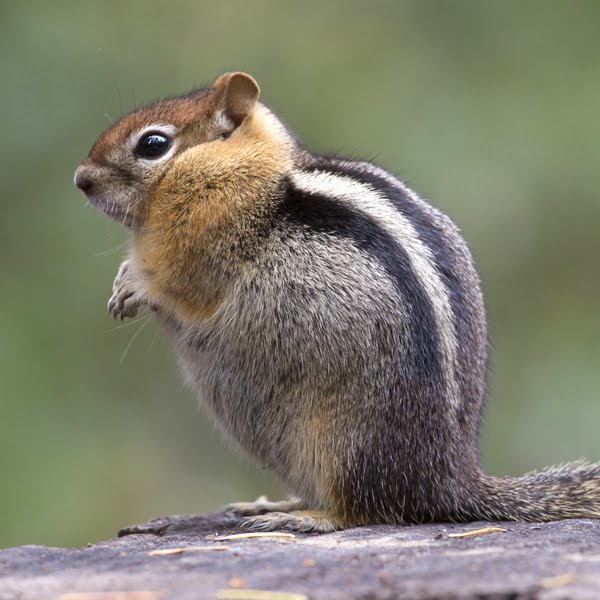
Up pops a golden-mantled ground squirrel. What a chunky little fellow! His belly looks as if he swallowed a balloon and his cheeks bulge almost hiding his bright eyes. I assume he has his cheeks stuffed with goodies. But no! When he stretches his head up the bulges smooth down and I realize he is just plain fat. He looks like a woodland Buddha. I thought squirrels were supposed to be slim little athletes. Is this an anomaly?
I soon realize these layers of fat must be quite normal. We find three more golden-mantled ground squirrels popping up on one downed log after another. Two are chunky cousins of the first and the third looks to be a youngster who hasn’t had time to put on his layers of winter food.
Chipmunk
When we return home I read up on what we’ve just seen. Golden-mantled ground squirrels are true hibernators, unlike chipmunks which are quite similar. Both have dark and light strips on their sides, but the chipmunk’s run along the side of his face too, whereas the golden-mantled ground squirrel has a plain cheek. He is a little larger too. The chipmunk goes into overdrive in the fall caching food for the long winter. They sleep a lot during the winter but rouse every so often and nibble from their larder. Golden-mantled ground squirrels prepare for winter by eating as much as possible. Often they end up with 30% of their weight in fat. By spring they will have used up their fat and emerge from hibernation ready to eat, mate, and scurry all too quickly through summer.
Doesn’t that sound rather fun? He gets to eat and eat and eat, then wakes up slim and ready to start eating all over again. Furthermore don’t you sometimes wish you could just sleep for three days and really get caught up on sleep? I’ll admit sleeping from October to May seems like overkill. I do look forward to my friends, books, paints, music….
And the little fella has one more reason to make me envious. He gets to eat truffles … those expensive little mushrooms that grow underground. Just for the fun of it I priced truffles on the internet …. $465.00 for 5 ounces of frozen black truffles. He gets to eat them for free! He even helps truffles by spreading their spores around in his feces.
I have to content myself with an occasional chocolate truffle … and not too many of those.
Sunday, October 23, 2011
Acorn Woodpeckers at Work
Wildlife Safari: Sept 20, 2011 -- I drew these drawings a month ago, but life has been busy. I wanted to add the color before posting them.
Fall has come. Grasses are golden, oak leaves are dulling, ash is turning yellow. Coolness in the morning air. Its not a great acorn year, at least not where I’m parked; yet there are enough to keep a family of acorn woodpeckers busy storing their winter food supply.
Watching the colony of acorn woodpeckers is a treat! They are such busy, talkative birds. Their antics remind me of a covey of clowns at work. I think there are only four birds using this granary at ‘mid-canyon’ at Wildlife Safari. At least I’ve only seen four on the granary tree at once. Some years the colony is twice this size. Acorn woodpeckers are unusual in that the family group stays together throughout the year and more than just the biological parents care for the nestlings.
Now that the acorn crop is ripening the woodpeckers are busy harvesting hundreds, if not thousands of acorns. One after another each bird flies off to one of the nearby oaks and wrenches an acorn free. They then fly back to the granary tree, in this case an old oak snag. A good granary tree is used until it falls apart, so hundreds of holes have already been drilled. When the bird first returns to the tree the pointy end faces down the bird’s throat – the way it grew on the tree. But that isn’t the correct position for storing. The bird then has three choices. Most are taken to a fairly level branch, the ‘anvil,’ and turned around. Once positioned correctly the woodpecker searches out the right sized hole. Choosing the correct hole is a trial and error process. One is too tight, one is too loose. When the right fit is found he taps it in, always pointed end first. Later, as the acorns dry out, there will have to do a little rearranging – don’t want these acorns easily stolen by the local scrub jays and squirrels.
A few of the acorns still have their caps on. These seem just a little greener. A handy cavity was serving as a holding well for the capped ones. The wood was so old and cracked we could see quite a bunch had already been dropped in.
Sometimes the woodpecker chooses to hull the acorn as soon as it flies in. The shell falls to the ground and the two halves break apart. One at a time he wedges each half into a crack in the wood. I even observed one of the woodpeckers breaking the acorn half into smaller pieces and wedging those into a small crack.
We’ll be watching the granary to see if they succeed in filling all the available holes. One a good year there will still be a few acorns in storage in March. Last year was a poor year. By late December most of the acorn were gone. Fortunately the woodpecker forage for other foods too.
It is easy to tell the sexes apart. The male forehead goes from white to red, whereas the female has a band of black between the white and the red.
Note: Only the first set of drawings was drawn from life. We spent two wonderful mornings photographing the colony … and I ended up with plenty of reference photos to draw from.
Sunday, October 16, 2011
Otter Watching
Lake in the Woods, Douglas Co., OR, USA
Arrived 11 AM. After the wonderful otter encounters yesterday, we are back, hoping for more. Before we get out of the car we spot three otter on the far side of the pond, slowly heading our way. The otter are in and out of the edge of the cattails. Fronds sway and then one comes up in the open water munching on a salamander. In and out. In and out. Hunting is good. We wait quietly in the car, hoping the otter will continue working the edge of the pond and come right past us.
A mallard hen near us is becoming antsy. She swims from our left to our right. Sure enough. The otter are getting close. We hear the soft “plop” when each dives…. Then back into the cattails where rustling and swaying take over.
Can’t see the otter now. They are behind us. We are parked on the dike that impounds this pond, parked so close Dale would get his feet wet if he stepped out.
Suddenly we see a thin string of bubbles rising to the surface. The otters know darn well where we are. The string of bubbles draws a wavy line right past us, probably within ten feet. One by one the three pop up to our right.
A big Douglas fir log reaches into the pond just far enough away for the three to climb aboard. They shake first and then stare for a moment. When one turns I get to appreciate its long muscular body and heavy tail. It’s an adult and two youngsters.
Since the otter appear to be heading away from us we decide to go over to the other side of the pond. I get out of the car at midpoint while Dale drives to the far side. We both sneak down to the pond and wait.
Darn. I’m too late. The trio have already passed my spot. They are busy hunting salamanders out in the open pond. I don’t want to disturb Dale’s chances so I stay put and sketch. The pond is still. Air barely moves. High above me I hear far off white-fronted geese. The geese are migrating, soon to be in the Klamath Basin. Their high voices soon fade. Stillness hangs in the air …. Yet the water along the edge to my left is sending out ripples, probably a mallard feeding along the edge. Quietly I reach for my camera.
It’s a fourth otter, very close, but barely visible because of all the cattails. Underwater one moment and then water slipping off him the next. For just a moment he comes up on a log near me … never looks at me. I don’t think he knows I’m here. All too soon he continues on his way, heading towards Dale. I stay put and figure it’s a good time to catch up on my notes.
I’m nearly done writing when two mallards explode out of the cattails across the pond from me. Ah Ha! Maybe I’ll have another otter opportunity.
It is easy to watch the otter’s progress. I just look for swaying cattails fronds. I sit very still, full of anticipation. Soon the otter is close. I can’t see him, but I can hear him: cattails being pushed, the chewing of his salamanders, the plop of his next dive. Most of the pond is edged with a six foot fringe of cattails, but I’m sitting where fishermen have made an opening. Not a big opening, but big enough for a nice look if he swims past me.
That toadie! This one knows where I am. The tell-tale string of bubbles shows me he is swimming past my opening. Then, to my right, I hear more rustling and munching. Ah well. Just being so close is a treat.
Soon the otter are back out in the center of the pond feeding. Too far for good photographs, but I can sketch. I find it interesting that they sometimes hunt in the cattails and sometimes they hunt out in the open pond. The pond is full of weeds and apparently provides excellent salamander habitat in both places. This pond has plenty of fish too, but the otter are hunting the easy prey.
One last treat before they disappear into the cattails for a rest. The family comes out on a log across the pond from me. They have a playful tumbling match with lots of ‘chirping.’ If I didn’t know otter I’d be looking for a bird. Their cheerful calls carry easily across the still water to me. We’ve watched the otter enough to know they arrive and leave the pond from this location. The tiny stream that enters the pond flows just a few feet from this log.
Wednesday, October 5, 2011
Signs of Fall
Douglas County, Oregon, USA: Sept 29, 2011
Last night we heard geese flying overhead. Flock after flock gabbled as they flew over our bedroom, too high and too many to be our local flock heading from nearby pastures to nighttime pond. We seldom hear migrating geese, maybe because we are usually too insulated from night time sounds.
As we head out of town this morning there is a surreal beauty. Smoke fills the Umpqua Valley. Fog is cool and grey, but this has a brownish tone and warms the yellowed grasses. Even the nearest hills are soften by the murky air and just a little farther the hills are shapes without detail. After a long dry summer we’ve finally had just a little rain and now heavy dew. The nearby ranchers have a brief window of opportunity to do their field burning before falls rains soak the ground.
At the eastern edge of the valley the air clears. Blue sky above and sparkling dew on every blade of grass and leaf. A slope on our right is overgrown with teasel. Amongst the tall stems are scattered a field of crystal lollipops. It’s actually webs left by orb weaving spiders, but in the crisp, clear air they look like crystals. The golden teasel and sparkling webs and low morning sun sing of the end of summer. Even the turkey vultures are responding to the end of summer. At least a hundred soar high above me, slowly drifting in a southerly direction.
Another hour and we are at Lake in the Woods. Fall is in the air here too. Rusty brown hemlock needles drift down with every slight stir of the air. The ground is dotted with the colorful needles and more float on the quiet pond. A few of the cattail fronds are turning yellow. Dragonflies still dance over the dark pond, but few species are left this late in summer. I see turquoise and black darners, rusty-red autumn meadowhawks, and the flashy black and white wings of eight-spotted skimmers.
Soon after arriving we spot an otter family. Here, they too are a sign of fall. We never see them here in midsummer. I think they den somewhere along the creek and only come to the pond when the pups are old enough to travel. Twice we have photographed the otter feeding on rough-skinned newts here (see my blog post Aug 2010: http://elvafieldnotes.blogspot.com/2010/08/newts-for-dinner.html ) . As a result of the photographs we sent to Dr. Edmund Brodie from Utah State University, some researchers came to Lake in the Woods this summer to catch some of the newts. Dr. Brodie is finding that the toxicity of newts lessens at higher elevations. A few years ago only one variety of garter snake was thought to be able to eat rough-skinned newts, but now they know of at least two other species including our otter.
Now that we have otter here again, we would like to see what they are feeding on … and, of course, we’d like to get some good otter pictures. I settle down near the pond edge while Dale goes to another spot. Three otter are in the center of the pond feeding. Soon two move on and I’ve only got one in front of me. By the time I start counting I figure I’ve seen this one catch 5 salamanders. Most dives are successful. Eight dives in eight minutes. Sometimes he munches on something small, but before long I quite sure he has eaten 15 salamanders! No sign of any of them being newts, but that does seem like one big Thanksgiving dinner.
My otter moves on and disappears into the cattails on the far side of the pond. Two mallards are on a log near me so I sketch them. When I finish I start walking to join Dale, but suddenly the mallards erupt in frantic flight. There must be another otter back in the cattails. I settle quietly with my camera well braced. Off to my left a level log just out of the cattails and floats on the pond. The log has been growing it own little garden for years. Lush grasses and forbs form a green carpet.
For just a moment an adult and a young otter pop up onto the log and greet each other affectionately … big, dark eyes; eyes high set on their heads; small ears; coat drenched in water. They snort and dive back into the safety of the pond.
Friday, September 23, 2011
Sketching at Sough Slough
South Slough National Marine Sanctuary, Coos Bay, Oregon, USA
Fog rides above us. Except for a noisy raven family grunting and croaking, South Slough is damp and almost quiet. Farther off a crow caws. Long summer grasses are golden, just barely moving in the quiet air. I feel a sense of waiting. The changing of the seasons is coming all too soon. My last three walks at home have been strictly for exercise … getting out of the house before the days gets too hot. Today Dale and I are at Sough Slough Marine Sanctuary near Coos Bay, Oregon. I’m in the mood to just wander, pausing here and there to sketch.
My first find is a crab spider on Queen Anne’s Lace.
A little farther down the road more Queen Anne’s Lace catches my attention. Some of the blossoms have curled into tightly woven cups. Down in the interior of one I spot the bright green of a little instar which almost blends with the greens of the fading blossom. I think it will grow up to be a stink bug.
As I near the old wooden bridge that crosses Winchester Creek I upset a song sparrow. He pops out of a thick huckleberry bush and scolds. I’ve disturbed his dinner. Parts of a smashed berry stick to his bill and more berries dot the branch he sits on. Soon he is back to the business at hand – eating huckleberries.
I cross the creek on Hinch Bridge. When the tide heads out the creek becomes tiny and rushes towards the ocean. Now the creek is swollen and nearly as high as it will get. The tide is coming. It still sluggishly pushes more and more water upstream. Dale stays on the east side of the bridge studying the green pine cones scattered on the gravel road. These cones are too green to have just dropped. Sure enough! Big dark eyes peer at him at eye level. There sits a chickaree (our western version of a red squirrel), munching away on one its recently harvested cones.
Loud honking comes from down stream. A narrow grassy valley follows the creek, with dense stands of Sita spruce on either side. The geese are flying towards us, following the valley upstream. Soon twenty geese are above us; then on their way, honking as they fade off into the distance.
I wander on down the road to where trilliums bloom in the spring. I’m hoping to see what a trillium seed looks like. I read recently that these seeds have a yummy spot , an enticement for ants to pick them up and carry them off to a new location. I’d like to see one of these seeds, but I think I’m too late. I find only one trio of trillium leaves. No seeds.
One the way back Hinch Bridge catches my eye. I sit down on a log to sketch. The creek continues to lazily head inland. Still damp and gray this morning, but pleasant sitting on the log. While I sketch two egrets fly over … white against the gray sky. I’m nearly done sketching when I realize the tide has turned. Sluggish water swirls slowly, some of it heading in the direction all proper streams should flow, towards the ocean. The daily mixing of fresh and salt water yields a rich mix of nutrients, a rich ecosystem for many animals South Slough is famous for.
Thursday, September 15, 2011
Stinky!
We’ve been home more than usual. Odd for us. Some days its too hot to go anywhere … and some days we get energetic and have been doing some serious yard work. That does have to be done once in awhile. Meanwhile we have nature right at our doorstep. This has been the summer of skunks, the common striped skunk. I haven’t seen one yet, but all too often we’re aware of their presence. Normally the encounter starts with Lucy’s loud “Woof, Woof!” in the middle of the night. Lucy is the neighbor’s Labrador. She is a sweet old dog who never strays far from home…. but our backyard isn’t ‘far from home.’
After the “Woof, Woof!” I hold my breath and listen. On good nights I hear the scramble of two or three deer hustling out of our yard. The deer love our grapes leaves, then the grapes; apple and pear leaves, then the apples and the pears.
On not so good nights all is quiet …. too quiet. About a minute after Lucy’s bark, skunk stench blasts us. I think the skunk must spray directly beneath our bedroom window. All too often we end up closing the windows just when the house is cooling down for the night. According to a recent Nova program skunks don’t spray unless really provoked. Somehow Lucy succeeds in provoking without getting herself sprayed. We must have a colony of skunks with a really itchy trigger.
When we first moved into this house we were somewhat unsettled to find we had skunks under the house. We half-heartedly tried to evict them, but generally speaking we all got along well together … until one night. The little dears waged war under our house! The stink was awful! I felt as though we should just give the house away. Our daughters went to school and anyone nearby smelled skunk. Dale went to work and the subject of skunk came up. I stayed home and hoped I’d become numb. It does go away …. eventually. Fortunately Dale was now motivated. He figured out a way to close off the foundation with the skunks outside and not trapped inside. He built a swinging door for our crawl space with nasty little spikes all around its edge. The skunks could easily push their way out, but getting back in just wasn’t going to happen.
Speaking of stinky, I have an even stinkier story. When I attended the University of Wisconsin I had a job in the Natural History Museum as a bone cleaner. My job was to end up with a box full of nice clean bones for each species I worked on: jumping mice, Swainson thrushes, flying squirrels, etc. Most of the specimens either came out of a freezer and I boiled them, or they went to the dermestid colony. Dermestids are little beetles very adept at cleaning up a carcass and leaving me a little pile of almost clean bones. Usually I worked a very flexible schedule, but one day my boss call and asked if I could possibly come down right now. A rather stinky package had just arrived.
I was told I was about to unwrap the third known record of a spotted skunk in Wisconsin. A farmer had shot and buried it six months ago! Just recently the University heard about the unusual specimen and asked to have it sent to the museum. The package didn’t smell all that great, so I took it outside to open. Unfortunately I made the mistake of opening the package in front of the air intake for the big, old multi story building. Whew! The whole place stank. I took the specimen back to the museum and for once I wore both a lab coat and gloves. As quickly as possible I reduced the spotted skunk to a tidy pile of relatively sweet-smelling bones. …. And off to class I went.
It happened my next class was in one of the University’s enormous lecture halls. I believe it held 300 students and was at least half full. I liked to sit near the front. All too soon students around me commented on skunk smell . I took a deep breath and commented too. I looked like any normal co-ed, and pretended I was as normal as I looked. Nobody guessed exactly where the smell was coming from.
After class I walked over a mile back to my dorm. Surely I was ‘freshened’ by then. But, no. As soon as I entered my dorm the subject of skunks came up again. It was time for action. I bagged all my cloths and hung them out the window and then I showered. Finally I could walk into a room without the subject of skunks coming up.
Do I know of anything stinkier than that incident? Oh, yes! Dale can do me one better. When he was working as a soil scientist in Alaska he found a humpback whale deliquescing on a beach. Much his surprise a black bear came running out from inside the whale. The bear obviously didn’t mind the smell, but Dale said he couldn’t stand getting close to the whale.
Subscribe to:
Posts (Atom)