Friday, April 20, 2012

Spring Sabbatical


Some of you have seen this little sketch before. When spring comes I want to embrace every possible moment of it! Time to be outside, not pecking away on my computer. So for a little while I’m going to take a sabbatical from blogging.

I’ll be back!

Friday, April 6, 2012

More from the Heron Web Cam

I’ve been watching the great blue heron web cam again. I never thought I’d consider a web cam a treat, but treat it is. In the wild I would never have such a good look at the nest behavior of a pair of herons. Meanwhile where I live we just broke the March precipitation record. March is usually one of Oregon’s wet months ... this was a soaker. Still getting lots of rain now that April has started.... a good time to stay indoors and enjoy something different.

If you didn’t see my last post, you should probably read that first. I’ve been watching a web cam put up by the Lab of Ornithology at Cornell, University, New York. ( http://www.allaboutbirds.org/page.aspx?pid=2433 ) The birds first nested in Sapsucker Woods, Cornell in 2009. This year Cornell put up a web cam before the birds returned in the spring. On April 1 I was watching when the female laid her third egg. Here are today’s notes:

This heron has an itchy chin.

April 3 -- 2:45 PM: With a little luck and information I’ve come back to my computer to heron watch. If the heron lays a fourth egg in the same time line, it should happen in the next couple of hours. Big IF. I’m going to sketch while I watch.

The female was on the nest when I first arrived. I knew right away I hadn’t arrived late for the party. One of the herons was standing, carefully tucking a couple very fine sticks into the nest cup. When I’ve looked at a heron nest from below all I see are rather coarse sticks. With the web cam I see fine twigs line the nest cup. It isn’t nice and fluffy like an eagle’s nest or a raven’s, but at least more comfy looking that I expected. I’ve seen adults bring in lots of sticks, but not little twigs.
I’m hoping for another egg. I’m looking for some gulping and maybe a little hunching. When I’ve watched a sandhill crane lay, it was obvious a lot of hard work is going on. Yesterday’s heron egg laying took me by surprise. The female stayed flat on the nest and I really didn’t know it had happened until she stood up. Now I know better what to watch for.

The male just brought in a funny looking stick. Lots of little branchlets on one end. Is that where little twigs come from? The female stands, then bows low with her long neck plumes wired out. She croaks as she dips, then reaches for the offering. All too soon it is the female that flies off. Darn. The waiting game is on.

The web cam even has sound. Occasionally I hear a heron, but there is also a pleasant chatter of crows cawing in the distance, a hen mallard quacking and maybe a cardinal. Canada geese erupt into a squabble every so often. There are more calls, but I don’t know my eastern bird calls well.

3:45 PM: The male starts calling. The female is on her way in with a stick. She doesn’t stay long. I’m juggling drawing and trying to get a little housework done. Nothing is going to happen while he is on the nest!

5:25 PM I’m still watching. The sun has gone down (remember the nest is on the East Coast and I’m on the West Coast). The female has been on the nest for awhile. The web cam gives us a surprisingly good image using just ambient night light. I can see her plumes, an eye, and even some bill color. The calls of spring peepers fill the night. Earlier over 34,000 people were watching the web cam, but now that it is dark the numbers of people have dropped way off.


The female still lies flat on the nest, but she is fluffing the long plumes on her back -- a slow motion bellows. The feathers go up ... and down ... and up ... and down. Is this it??

All is quiet for about a minute and then she stands ....... yes! A fourth egg lies in the nest. 5:26 PM West Coast time (8:26 PM cornell time). Laura, at the Lab of Ornithology, did a wonderful job of predicting when the fourth egg would be laid.

According to the web cam moderators four eggs is what they expect, although a fifth could come. Incubation is about 28 days. First egg could hatch May 24. It’ll be a long wait between now and then.

Followup: This pair of heron has had four youngsters in the past, and four is a common clutch. I’ve been taking quick peeks at the web cam several times a day. The last time I looked on April 5 the cam was shut off. I don’t think Cornell was expecting another egg, and the moderators must have been worn out by then anyway. Morning brought a surprise -- a fifth egg! Now to wait and see if all five hatch.

Sunday, April 1, 2012

Lucky Me! -- Great Blue Herons


No, I’m not one of the winners of the mega lottery. I’d have to buy a ticket first. My luck today was unexpected and unusual.

Three days ago a friend in Indiana sent me the link for a great blue heron web cam being broadcast by the Cornell Lab of Ornithology (http://www.allaboutbirds.org/page.aspx?pid=2433 ). I’ve taken quick peeks at various web cams since they became available, but usually the critter was sleeping on the job. It is fascinating to peek into a bear’s den or view the world from the top of Mt. Washburn, but usually one look is enough. This cam caught my attention. Cornell has set two cameras to work giving the viewers a very up-close peek into the private lives of a pair of great blue herons. I’ve spent many fascinating hours watching a couple of heron colonies near here, but always from far away and far below. These camera are so close that if the bird on the nest stands up, one camera shows only its legs. .... and its eggs.

There were two eggs when I took a quick peek yesterday, and two eggs this morning. I had lots to do, so I settled on watching for fifteen minutes before breakfast, and a couple of quick peeks during the morning. I watched the herons mating and then the male seemed to celebrate by bringing in half a dozen sticks. The female accepted each stick and carefully added it to the nest.They changed places, preened, and never seemed to sleep.

This afternoon the skies were spitting rain and ruffling the long plumes on the heron’s back. Not much going on but that was good. I had a telephone conversation to pay attention to and felt a little guilty I was even watching the herons while talking.
I almost dropped the phone. All seemed quiet. Looking back over the comments, others were anticipating the event. I’ve seen a sandhill cranes lay an egg (twice), and both times it took several minutes of hard work. .... so I wasn’t prepared. Suddenly mama crane stood up and there were three beautiful eggs, instead of two! One was a little darker than the others.

This cam is wonderful! While I write I have it on. Even though it is 2:15 in the morning in New York I can see enough to know the adult on the nest just stood up, pooped, scratched and then settle down again facing in a different direction.

After mama laid her third egg, she settled down again. The next time she stood, about fifteen minutes later, the new egg was drying to the same color as the others.

For more about these marvelous birds, be sure to go to Cornell’s site.

Wednesday, March 21, 2012

Warts and All, My Journal

Here come the warts ..... if you don’t know what I’m talking about, I promised to scan some of my journal pages, warts and all, so those of you who are interested can see my working process. (see my last post: Question -- March 8, 2012). I apologize it has taken me so long to follow up on my promise. Life has been busy.

Many artist’s journals are works of art -- beautifully laid out, lovely drawings, and carefully worded . A few of my journal pages qualify, but the vast majority of my pages are scribbled notes and sketching. I try to put the entries in while they are happening, or as soon after as possible. I want to capture what has just inspired me, and not worry about wording it carefully or making a sloppy sketch. I call it a ‘working journal’. I’m not about to tell you that is the way to keep a journal, but, for me, it works.... and has worked for many years. I’m just about to finish Vol. 39. I have a wonderful record of things I want to remember that goes back over 30 years. Many of my paintings have their roots in one of my journal entries; I often refer to an old journal to remember when to expect natural events (when do skunk cabbage bloom, or elephant seals pup); I savor old memories; I even save a few recipes; and a treasured sketch or two by someone else. I only wish I had started sooner.

More more of my ideas on journaling go to my post, “Thoughts on Keeping a Journal” -- Feb 1, 2011: http://elvafieldnotes.blogspot.com/2011/02/thoughts-on-keeping-journal.html

And now for some pages......

First an old one, from Volume 6. I sketched this page over twenty years ago when we were in Grand Tetons National Park, yet the style is similar to my current journals.
The next six pages are in the order they fall in my journal. I intentionally picked pages I never got around to blogging about. The first page is the beginning of a four day trip to Burns, Oregon. The Malheur National Wildlife Refuge is just to the south. The Malheur basin is host to a wonderful variety of birds. We stay in a little motel on the edge of town and spend our days photographing and sketching.

To get to Malheur from home we drove over the top of the Cascades, and see Mt. Thielson along the way.

The funny little squiggles at the top of this page is an attempt to record a Swainson’s thrush’s song visually. It does help me remember a bird song.

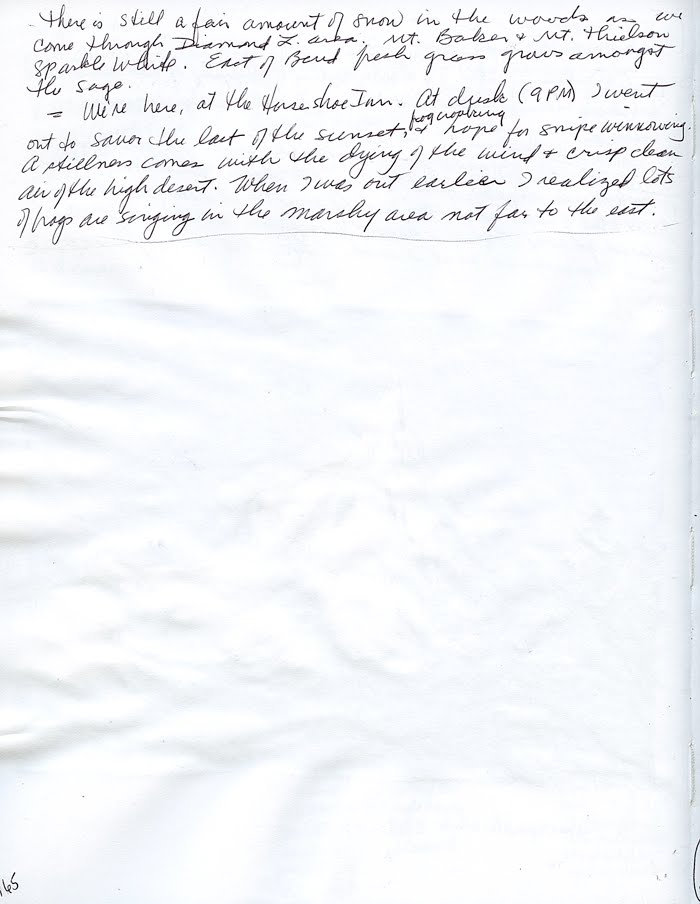
This page looks odd because three fourths is left blank. I know the paper in my journal is too thin, so I often leave the back side of some of the art blank .... so no writing shows through on the back side. The Mt. Thielson color sketch is on the other side.


Often while Dale drives the miles and miles of the open West I entertain myself with quick sketches. Here I focused on the variety of fence posts found in the thin, rocky soils of central Oregon. Part of being an interesting artist is knowing the variety a subject offers, not just the easy symbol. Fence posts offer a lot of variety.

If you bother to read the text you’ll find it quite jerky. Even with my words I’m not aiming for a polished product. That comes later. Far more useful to me to capture some good phrases and details that capture the moment, than worry about it flowing well. Words can always be edited.


The black spot on the right side bears mentioning. Before I added color to the red-winged blackbird I was sketching with water soluble ink in a fountain pen. I wanted more darks without adding any more lines, so I just scribbled off to the side and dipped by water brush into the scribble to pick up some ink.


Quick sketches ... probably drawn while Dale stopped to photograph ... The top two could have been drawn while he was driving. I can’t remember. The middle one is of huge bales of hay lined up in a row. The bottom one is an avocet.


I spotted the baby great horned owl as we drove by a small ranch. Most of the country is very open. Ranches usually have a few trees at the homesite .... and that is where the red-tailed hawks and the great horned owls nest. This owl was old enough to fly, but still covered with down. He was perched on the corral fencing. You can still see my pencil lines. Sometimes I pencil first. Sometimes I jump in with ink right away.

The pencil sketch in the lower left is a flop, so I didn’t bother adding ink. The drawing of the swallow was almost surely done from my laptop that evening.

In this instance I filled 6 pages in a 24 hour period. The number of pages I fill in a full day in the field varies a great deal, but seldom more than this. I try to do most of my writing on the spot or as soon after as possible.

One last sketch, from a different journal. Sometimes I tackle a much more detailed drawing in the field. While Dale spent two or three hours photographing the flickers excavating their nest hole, I had plenty of time to almost complete this drawing.

I just found a marvelous quote, so appropriate for this moment:
"There's only ONE way of Life, and that's YOUR OWN." ... THE LEVELLERS
Found at the end of "Drawing and Painting Birds" by Tim Wootton .... a nice book on bird art.

Thursday, March 8, 2012

Question

I usually get the most 'comments' when I post about art ... so, obviously, a bunch of you (my readers ) are artists, or at least interested in the art process. .... and for the others of you, never fear. I'll soon run out of art posts and get back to organizing the several posts I have in my 'to do' basket.


At least two of you (my readers) expressed a desire for a peek into my sketchbooks. Are there more? If there is an interest I'll post several unaltered pages, warts and all. I have to admit I'm probably a fool for even considering it. Some of you may be operating under the illusion I keep a beautifully laid out journal. Ha! For others, is may be liberating. Once upon a time I thought my journal had to be neat and tidy ... and I was always way behind in putting anything into it.

Tuesday, March 6, 2012

Sketching Versus Drawing

Life has been all too hectic lately. But I do have this post on sketching versus drawing ready -- another essay I wrote for The Sketching Forum ( http://sketching.cc/ ). More wanderings in the field soon to come.

A drawing of the cabin where Dale and I honeymooned in northern Wisconsin. Drawn in 1964.


When I joined The Sketching forum I knew I was joining a ‘sketching’ forum. I didn’t bother to differentiate between sketching and drawing. I looked at various postings and figured I belonged. Then the back and forth of ideas got me thinking. What is the difference?

At first it wasn’t clear to me. Where does one draw the line between one and the other? It is rather like fine art and illustration. Often you know which one you are looking at, but there is also a grey area in between.

About two weeks ago, I was going through some of my old journals. Suddenly it dawned on me. I could draw long before I could sketch. In fact I could draw quite well long before I could sketch, partly because I wasn’t even trying to sketch well. Sketching as an art form wasn’t even on my radar. My earliest journals are mostly words, some quick thumbnails that were only intended to remember an event, and some careful drawings.

Oh how I wish I had appreciated the value of sketching all along. I have to admit I was exposed to some sketching in college. Unfortunately the instructor thought we’d learn by working from the same subject arranged differently .... the subject was pieces of a junked car. You can imagine how much that inspired me! He didn’t succeed in telling my why I was drawing pieces of a junked car. I only knew that when I got mad and scribbled crap, he liked it. I had no clue I should have gone looking for a different class. I finished college but never took another art class in college. After college I took a three year correspondence art course and learned a great deal ... about drawing, but not about sketching.


I bumped along for twenty more years. I painted a lot and did some pen and ink illustrating. Had my work accepted in some very nice places, but my ability to sketch hardly grew.


As I mentioned in an earlier post in 1984 I attended a week long workshop taught by Jack Hines, Jessica Zemsky, Veryl Goodnight and Robert Bateman. And I went to the same workshop in 1987. Suddenly I saw sketching as a means to become a better artist -- learning to really see the world and to capture it. I wanted a sketch to say something, to capture the character, and not just be a reminder. I dared to be much bolder. There is a quote in The Art of Robert Bateman, “ A great master once said, ‘In order to learn to draw you have to make two thousand mistakes. Get busy and start making them.’” I think this applies to sketching even more than drawing.


My ability to sketch jumped forward. I’ve long sensed that real growth in my artistic ability tends to be in jumps, not an even path. I jumped. Thumbing through my journals for the next few years show some sketches that sing, some fall flat on their face .... but I was reaching out and trying. My sketches had very little attention to fur, feathers, bark ... Form and light had suddenly become more important. Thinking about a light source is often the key to good form. Successful sketches captured the gesture. Each sketch tended to be of a specific individual, not something generic. Sketches were done quickly. Drawings were done carefully.
A wonderful byproduct of taking sketching seriously is that I incorporated some of my new found knowledge into my drawings. Instead of relying on texture and detail, I began incorporating gesture, form and light along with the texture and detail. This Swainson’t thrush was carefully drawn in pencil, yet has some of the freshness of a sketch.
When I’m sketching I’m usually working quickly. Either my subject is going to move or I don’t want to keep Dale waiting. In the long run I think having to push myself has been good. At first I judged my sketches in terms of how well they were done versus a careful drawing. I now realize they are different art forms. A lovely loose watercolor can be just as great a work of art as the carefully controlled oil painting.

I have a strong sense that sketching comes from somewhere within, sort of zen. When I’m drawing I’m thinking about what I’m doing; but sketching doesn’t give me time for much thought. I’m accessing a skill I’ve slowly developed.


I’m currently enjoying a very different art journey than the one I followed for so many years.

Friday, February 24, 2012

Field Sketching

One of my favorite field sketches. I look at it and remember how chilly the day was. Dale and I were in Yellowstone, watching a sandhill crane nest. I was scrunched in the backseat of our car so that both Dale and I were on the side of the car facing the black bear. The elk carcass had been hidden by winter snow. When spring came this bear or another pulled the carcass to shore. This bear spent the next few days feasting and sleeping near his treasure.

I recently posted a series of field sketches on "The Sketching Forum" (www.sketching.cc/} and have decided to do it here too. Plus I’m in desperate need of seeing if I can post via Dale’s Mac versus my PC.

Some of these sketches are quicker than others; the purpose of some is different than the purpose of others. So I’ll add a running commentary along with the drawings to explain why I did each one.

It been a good exercise to think about my sketching. It got me thinking about why do I sketch? -- My purpose is twofold. I sketch to capture moments in nature, often to capture a specific event or behavior; and I sketch to get better at sketching. My early sketchbooks tend to have very sloppy ‘just to remember the moment’ sketches and ‘encyclopedia’ type drawings . I tried to draw accurate animals -- stiff. Later I realized the importance of the character of the animal.

Capturing this ellusive character of an animal means sometimes I have to work quickly. I need to allow myself to make mistakes and to feel O.K. about the scribbles that happen along the way. If you thumb through my journals you’ll find a few drawings scratched out … I was way off base. You’d also find some drawings unfinished. If I don’t know where to go with a sketch of an animal I think it is better to quit than to create fictitious information. Mostly you’ll find a variety of loose sketches tucked in between lots of words. Very few pages are properly laid out, neat and tidy. In my mind it is a ‘working journal,’ not a finished product.
I’m sure the more I sketch the more information I put into my grey cells. Hopefully I’m putting them in faster than they are falling out! I don’t say that lightly. During the ten plus years Dale was disabled I didn’t sketch nearly enough and I basically quit painting. I was time challenged. I knew rust was gathering in my veins. Dale got two new hips in 2009. I’ve now had two years of finding a decent amount of time to sketch and do some light painting. I doubt I’ll ever go back to gallery painting. I’m having too much fun sketching and writing. The writing part is new. I’ve scribbled in my journal for years, but I’ve only come recently to writing something for other people to read. For me the writing and the sketching are tangoing together. Both help me see nature and bring me close to it.

For me capturing a bird that I’ve never sketched takes practice. I wish I could just pop a little bird on a branch and know what kind of bird I’m looking at. Sometimes I get lucky, but I get luckier if I’ve drawn it before.
So I practice. Here is an example of several robins, all drawn from life. I’m convinced some of the information remains stored in my head when I do little practice sketches like these.
Here is a different type of practice drawing. I know I’ll find myself in situations where I want to be able to sketch good ravens on the wing. Here I looked at our photos on the laptop and made a series of careful sketches – pencil first and then ink. I probably could have learned just as much with careful pencil drawings in a fraction of the time.
I can’t say this little field sketch is particularly well drawn, but it does capture the interaction. A raven flies low over a vast expanse of marsh, looking for opportunities to steal blackbird eggs. The blackbirds are frantic and mob him. If I want to do a careful drawing later on I’ve got one of the most important elements here.

And now for some quick sketches on one of my favorite birds, sandhill cranes. For the past several years we have been fortunate to know of a nest in Yellowstone. I usually use a spotting scope when drawing the birds. I either sit outside with the scope on a tripod and I sit on a stool, or else I mount the scope on the car window. Either way both my hands are free.


I could have erased the words with photoshop elements, but it gives you a better idea of my journal if I leave them. I look at all these crane sketches and they take me back to a special place where I’ve spent many, many hours. The little arrow by the crane's neck is just a reminder to myself I should have drawn a longer neck.


I’m happiest when Dale is in position to photograph and I’m free to sketch.


Another of my favorite field sketches. I love it when I can say it all with just a few lines. Learning to draw just the essence has been harder for me than trying to include every feather.