Thursday, May 2, 2013

Lucky Me! A Kingfisher Tale


Douglas County, Oregon

Sometimes long, long stretches of patience pays off and we get an unusual photograph ... and sometimes luck just jumps in and things happen so fast I have to pinch myself to be sure I wasn’t just dreaming.  

Dale and I were slowly driving along when I spotted a kingfisher sitting in a tree next to the road.  Kingfishers always seem to perch just a tad too far away or flush as soon as we get near.  Rule #1 when photographing wildlife is to ‘give it a try.’  Dale slowed down and I eased my camera up on the bird.   

I had just time enough to fire off a couple of shots and check my exposure when suddenly the kingfisher’s mouth opened.


Wide....

and wider, but no sound.


Suddenly I realized I was watcing the kingfisher cough up a pellet ... just like owls do!  


I’ve since learned a quite a few birds, that swallow whole prey items, cough up pellets.  In addition to owls, hawks do, and crows, herons, and kingfishers.      Probably several more species of birds do too.

That feels much better!

Thursday, April 18, 2013

White Petals in the Breeze: White-tailed Kites

Douglas County, Oregon -- March 2013
I’m on a hilltop on the Mildred Kanipe Ranch, waiting.  Waiting.  Mildred loved this land.  She grew up on the homestead, never married, and ranched here all her life.  She referred to herself as the only son her father ever had.  Her sister choose a more normal pursuit and became a school teacher.  

Mildred bought a piece of land near her father’s when she was only 18.  Later she wanted to join the two properties.  In order to pay for the land which would join the two, she ran a dairy for eight years.  ... “Let me tell you, don’t ever get a dairy, unless you want to work yourself to death.  Because it don’t make any difference.  If you died, you’d have to get up and milk those cows.  They got to be milked every morning and every night.  And 365 days a year.  And 366 on leap year.”  I can almost hear her chuckling over that last comment.

Mildred died in 1983.   She gave her land, almost 1100 acres, to the Douglas Country Parks with stipulations that ranching could continue with other stipulations designed to protect the land and the native wildlife. ... and for people to enjoy.  She also instructed that she be buried in her overalls, on her side.   Near the old farmhouse a white picket fence surrounds her simple grave.

There is more about Mildred on this website: http://www.mildredkanipepark.org/history.htm.  If you go to the link, be sure to click on:  “Read an article published in MS Magazine 1982”

So today I sit on this hilltop and think about Mildred and the land she loved.  Mostly I’m surrounded by unkept pasture dotted with lichen festooned English hawthorn -- the bane of this area.  Farther off are a few large, open-grown oaks and scattered clumps of woodlands.  Peacocks squawk down at the homestead.  It is strutting season for them.  The peacocks will be shimmering, shaking, and fanning those glorious tails.  The peahens pretend to look unimpressed.  

Near me rises a dense island of relatively young Douglas fir, about 50 feet tall.  A pair of white-tailed kites perch in the tippy tops of the fir.  They preen.  They stretch. Occasionally I hear, “Kip, kip,...”  Is it the female calling the male over?  I hope.  That is what I’m here for.  

I suspect the it is the female on the left perch, a sturdier, crooked tree tip.  The second kite perches on a flexible tree top.  Just a little gust of breeze bobs him about.  When he spreads his wings to catch his balance, I get hopeful.  Will he join her?  No, he is just hanging on.  

Chorus frogs call in a nearby ravine, a nuthatch’s nasal song drifts from within the Douglas firs, a pair of noisy ravens fly past.  Waiting here is pleasant duty.  The ground is damp and full of last year’s dried weeds and this year’s green grass.  To the south, snow speckles the top of Mt. Scott.  A rich garden of mosses and lichens grow on an ancient fence post near me.  Vole tunnels meander throughout in the overgrown grass .... good habitat for feeding the kites.

I’ve been nearly half an hour when the “Kip, Kip” calls become more insistent.  The calls remind me of a female osprey we once watched on her nest.  No eggs in the osprey nest.  The female started calling persistently; the male flew in, copulated, then left.  Twenty minutes later the whole process repeated -- three times an hour for two hours and then we left.  It was an eyeopener for me.  As the daughter of prairie chicken biologists I got the impression the hen visited the booming ground once or twice per season.  In recent years I’ve come to realize some birds are far more sexually active than that.  Wood ducks copulate off and on all winter.  I’m not sure when the kites plan to nest, but I do know they were copulating two weeks ago when we were here.   


Both birds are calling!  The male lifts up and swings over to the female still perched on her bent over tree top.  He floats down like a white petal drifting in the breeze.  Kites are beautiful.  Gleaming white feathers against a grey sky.  His yellow feet are balled.  Very gently he settles on her back, her tail goes up and twists one way while his twists the other.  All too soon he is on his way.  She remains tail up for a moment while he flies past me and on to the open valley to the west. 

I settle in to wait some more.  Sometimes the kite hunts in the field I’m sitting in, but not now.  I’m going to stay near her rather than hiking over the rise to where he probably is hunting.  He likes a spot about half a mile away.  Kites are beautiful while they hunt.  They hover in one spot after another while the watching for a vole below.  When prey is spotted they cock their wings back and float down.  

While I wait the clouds have thickened.  Stillness seeps in as if spring is stepping back and allowing damp, grey winter back in.  The female kite is quiet.  I brought camera and notebook with me, but not a sketchbook.  I can keep my eye on my subject and take notes, but as soon as I start sketching I don’t look up often enough.  

Both birds are calling!  The male lifts up and swings over to the female still perched on her bent over tree top.  He floats down like a white petal drifting in the breeze.  Kites are beautiful.  Gleaming white feathers against a grey sky.  His yellow feet are balled.  Very gently he settles on her back, her tail goes up and twists one way while his twists the other.  All too soon he is on his way.  She remains tail up for a moment while he flies past me and on to the open valley to the west. 


I settle in to wait some more.  Sometimes the kite hunts in the field I’m sitting in, but not now.  I’m going to stay near her rather than hiking over the rise to where he probably is hunting.  He likes a spot about half a mile away.  Kites are beautiful while they hunt.  They hover in one spot after another while the watching for a vole below.  When prey is spotted they cock their wings back and float down.  

While I wait the clouds have thickened.  Stillness seeps in as if spring is stepping back and allowing damp, grey winter back in.  The female kite is quiet.  I brought camera and notebook with me, but not a sketchbook.  I can keep my eye on my subject and take notes, but as soon as I start sketching I don’t look up often enough.  


Mildred would have been tickled to see the kites.  I doubt if she ever saw one.  They were seldom seen when we moved here 30 years ago.  I bet she would have thought they are as pretty as her peacocks.


Friday, April 5, 2013

Watching Egrets

Plat I, Douglas County, Oregon

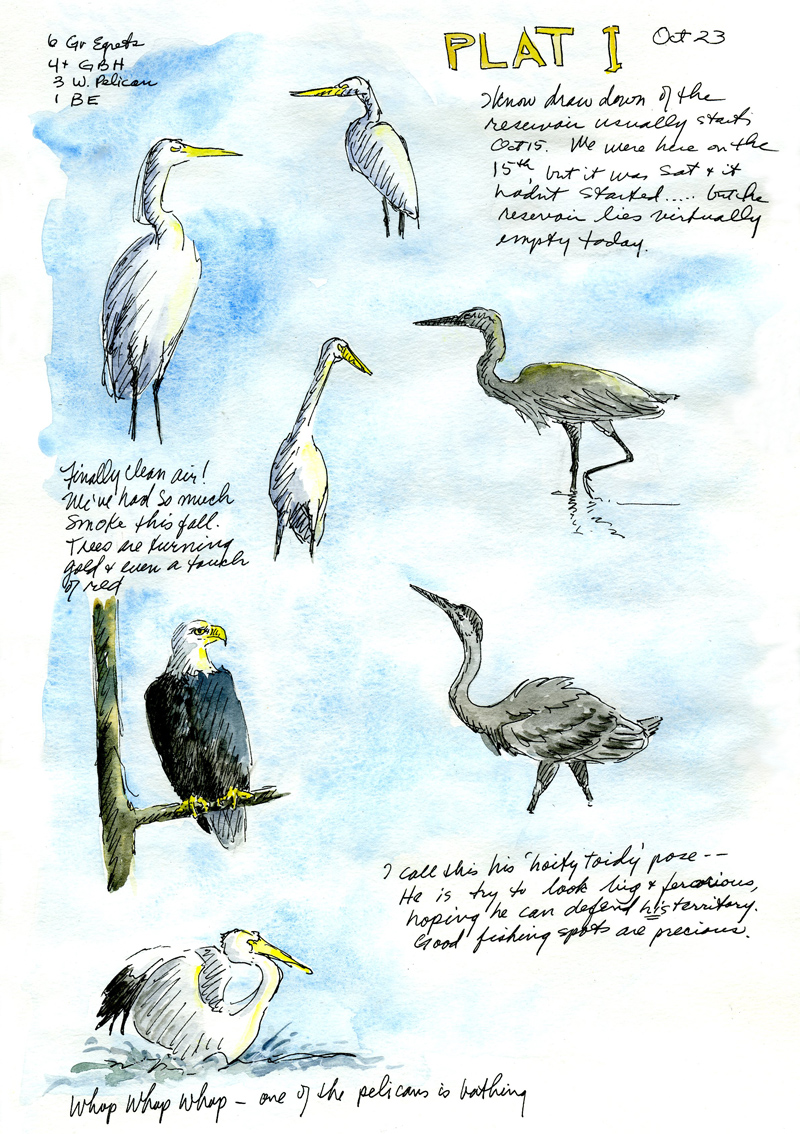
My sketches and notes come from early winter.  I'm finally finding a little time for catch up!  Here are my notes and sketches from wonderful times watching our local egrets foraging.

Late afternoon sun glows on fishing egrets, giving a warmth to their whiteness.  Often their necks stretch straight.  One pauses; looking; waiting for motion beneath the water.  Suddenly he turns, cocks his head, and freezes.  Relaxes.  

Out goes his neck!  Head plunges into the water.  Nothing.  He gathers himself, waits for the water to still and watches.  

Splat! This time he has a fish about four inches long, maybe a perch.  He deftly flicks his catch into the air, re-grabbing it head first.  An easy swallow.  The lumps quickly travels his long, slender neck.

The water soon stills again.  The egret’s reflection barely ripples as he slowly stalks, then pauses.  
Splat!  This time the egret comes up with a small crayfish.  This lump also slides easily.

After fishing this shallow bay for fifteen minutes he waits longer between opportunities.  He flies 50 years to the nearby mud flat and preens a few minutes.  Not for long.  Long careful strides as he eases back into the same bay.  

The sun is just slipping behind the hill, giving a lavender cast to the sky and the water.  His feathers, no longer warm and sunny, now harmonize with the grays and lavenders.  

So many fish!  Most of his prey is small, some very small.  He must have caught a least a dozen little fish while we watch.  Some were just tidbits ... and one crayfish.

As dusk falls the several killdeer have positioned themselves scattered along the edge of the shoreline.  It was their reflections I noticed.  The birds blend into the mud.  Our egret has finished fishing.  He flies to the vast expanse of mud and joins other egrets off in the distance.  


Thursday, March 21, 2013

Two Books Ready!

“Combining lives of adventure and fun with a dedication for some of the best public-spirited nature science investigation in the history of America, Frances and Frederick Hamerstrom pledged their all to accomplish great things.  Stories of the appropriately wild lives of the Hamerstroms, which included work that saved the Greater Prairie Chicken in Wisconsin from going the way of the dinosaur, fill every corner of this marvelous book...  The hand-crafted tales in these pages bring these brilliant, charming people back to life again, in all their natural elegance, gentle kindness, knife-sharp precision and ultimate glory.  As someone who knew them both and loved every moment of knowing them, I couldn’t be more joyful that the memory of Fran and Hammy has been kept green by their family and friends.  Now you can “know” them, too.
--- Mark Scarborough
author of “There’s No Place Like Rome,” and Wisconsin journalist.


Last December I wrote in my blog that I was immersed in two book projects, both involving my parents.  What I didn’t realize at the time is that it would evolve into three book projects. Two of them are done!  The third, a book for young readers by Susan Tupper to be published by the Wisconsin Historical Society, isn’t really my project.  I helped with editing for content and gathering of visuals; now that project is in the waiting mode.  

My two books projects also involve my parents.  If you don’t know much about my parents be sure and read my December post:
Briefly --both my parents were ornithologists who spent their career working on prairie chickens for the State of Wisconsin.  They also made a significant contribution to raptor research.  My father was one of few who earned his Phd under the famed ecologist, Aldo Leopold, and my mother was the only woman to get a degree under Leopold, a masters.  

After my parents died, Deann De La Ronde, a dear friend of my parents, helped me collect an anthology of stories about my parents.  I self published it as, “Hamerstrom Stories” in 2002.  Now, just over ten years later I’ve granted permission for a new edition which includes ten new authors.  The 336 page book is being released by Golden Sands RC&D Council Inc, a non-profit organization that works to preserve Grasslands in Central Wisconsin -- where Wisconsin’s prairie chickens still live.  Books ordered directly from R. Schneider, Publishers will have most of their cover price go to 
Golden Sands.  Books ordered through Amazon.com with have a much smaller portion of the profits go to Golden Sands.  I have directed any monies that I might receive go to Golden Sands.  

The gentle stories ... in this book combine to produce a book of rare appeal and quality.  Alan and Elva are lucky to be the children of exceptional parents.  Instead of going to bed early when the moon is full the boy and girl explore the magic night on treks with mom and dad.  During all four seasons, the family becomes a part of the natural world and its wonders.  They make friends with deer they espy by leaving apples for the animals to find; they discover that some flowers stay wide open at night while others close in sleep; ....  
-- taken from the Publishers Weekly  review that followed my mother’s original publication of “Walk When the Moon is Full.” I’ve deleted the references to the original art.  

“Walk When the Moon is Full” by my mother, Frances Hamerstrom, was first published by Crossing Press in 1975.  The little book stayed in print for about 25 years!  There was still some demand for the book so I limped along for a few years making copy-machine copies.  When the Lora Hagen was formatting the new edition of Hamerstrom Stories, I suddenly found out Lora ( part of R. Schneider, Publishers ) and I could put out a new, beautiful edition of “Walk When the Moon is Full.”  I had the joy of creating the illustrations for this edition.  

Either book can be ordered through Amazon.com or through R. Schneider, Publishers.  Remember a much larger portion of the purchase price of “Hamerstrom Stories” goes to supporting grasslands if you order directly from the publisher.  To do that:

Walk When the Moon is Full --  $8.95@Hamerstrom Stories -- $29.95.  If you live in Wisconsin, add 5.5% sales taxShipping and handling is $5.00 for the first book, $1 additional for each additional copy of ‘H Stories’ and 50 cents additional for each additional copy of ‘Moon’.  Combined orders welcome.  
Mail orders WITH YOUR ADDRESS and check or credit card info to:  
R. Schneider, Publishers
312 Linwood Avenue
Stevens Point  WI  54481


I’m not the one sending the books out, so I won’t be able to autograph them for you.  


A nest full of great horned owls -- one of my illustrations in 
"Walk When the Moon is Full"

Monday, March 11, 2013

Herbert's Pond: Part II


Note this is Part II.  Part I should be read first.

I did read go home and read about wood duck behavior on Cornell’s “Birds of North America Online” (http://bna.birds.cornell.edu    subscription required).  I suddenly realize I have been watching more courting behavior than I realized.  They seemed to be the thirstiest ducks  imaginable, but all that bill dipping is one of the behaviors.  I saw a lot of that!  The other behaviors happen very quickly.  I think the video is a really good idea.  

Maybe if we arrive at the pond early, they’ll be even more wound up.  But, for some reason, we just can’t get out of the house as early as I would like.  I write in my notes:

“Haven’t started and we’re late already.  8AM.  The sun is actually shining  -- visible!  Of course it always shines -- somewhere.  In winter it is a rare morning that we wake up to sunshine.    We’re just heading out the driveway and I’m wishing we were already at Herbert’s Pond.

We arrive.  Quiet.  Don’t even see a wood duck!  Have they left, flown to their nesting territories?  Then I find them sleeping amongst a tree that has fallen into the pond.  Some on low limbs, some in the water.  This is what we scrambled for!”

Before long some of the wood ducks head our way.  A little chick scratch (corn) thrown onshore helps to convince them we are some of those ‘good humans.’  The corn is soon gone and the ducks get back to paying attention to each other.  

Bill dipping is happening all the time.  It looks like a quick sip of water, but they’d be as big as watermelons if they were really drinking all the time.  When I watch carefully I see a hen bill dipping.  

Another frequent behavior is a quick chin up, usually by the drake but I saw a hen do it too.  

We also watched mutual preening.  A hen and a drake snuggle up next to each other and nibble at each other’s long head plumes -- very tender.  Really quite sweet to see.  

I start videoing.   Last summer I first dared to push the video buttons on my CANON 7D camera.  I still haven’t shot a total of an hour of video. Shooting video is a challenge.  By the time the duck actually does something, it is way too late to push the button..... so I watch for birds that seem fairly engaged, start the video and hope something happens.  As we often say, “It’s only pixels.”  What we don’t want can be erased.  

I get so lucky!  I’m filming a small cluster of wood ducks bobbing about, bill dipping,  when suddenly one does the head flick, that ever so quick head fluff / rear up that happens so quickly I wasn’t sure quite what I had seen when I first saw it.  With the video I can slow it down and see the exact sequence of movement:  head fluffed the drake dips his head down then rears up and flips his head back in a flash.  Back to normal. It takes about a third of a second!


The beautiful display catches the hen's attention.
I keep watching the trio of woodies -- two drakes and a hen.  Usually a drake is on each side of the hen, but every so often one swims in front and fluffs his crest.  There is a reason a wood duck drake has all those iridescent colors on his head.  What a show off!  Suddenly he turns broadside to the hen and flashes her -- another of the ‘behaviors.’  First he bill dips, then raises his crest, quickly shakes his head, and then, ever so fast, he reaches back as if to preen his underwing.  In the process he flashes his wing, showing a blaze of iridescence.  Wow!  With my eyes I just thought it was a quick preen.  After reading about the different behaviors and actually catching it on video, I am so impressed.  He knows how to show off his beautiful feathers. 
Soon after, I see that the hen is ready.  She lays flat out in the water in front of one of the drakes.  He approaches, grabs the long feathers on her head and mounts her.   

.... and during all this duck watching, did Dale get some good photos?  Oh, Yes.


Thursday, February 28, 2013

Herbert's Pond: Part I


Feb 15: ....We pulled into Herbert’s Pond on our way home from Grants Pass..... wood ducks!  Usually wood ducks are all too private.  They ease off as soon as we get anywhere close; but these are sharing a small pond with a gaggle of ‘funny ducks,’ i.e. various shades of domestic.  The wood ducks seem reasonably tolerant.
It is almost sunset so we don’t have much time. I immediately start to sketch.

Feb 17:  We arrived back at Herbert’s Pond late morning.  Before parking I got in the back seat of the car, behind Dale, so we could both sit on the pond side of the car.  While he photographed I sketched.  
Two double-crested cormorants sun themselves on a partially submerged log.  Already their faces have turned bright yellow, but no ‘crests’ yet.  That will come closer to nesting time. 

For a moment I thought my stomach was growling.  No, just the mumblings of the cormorants.  Then “HAANNK!”  Loud.  So loud I startled.  I thought someone had come up behind me.  Then I realized it is just more cormorant talk.  Apparently he said, “Let’s go fishing.”  Both slipped into the water and have been making frequent dives.  One comes up with a fish and tosses it quickly.  Down the gullet it goes.  

The cormorant dives a few more times but soon heads back to his log.  A coot has been enjoying the log, but there is no doubt in the coot’s mind as to whether the log is his or the cormorant’s.  Off he goes.  

Just before the cormorant climbs onto the log he ruffles and shakes .. a quick splash bath before climbing up.  Water droplets pearl on his dark feathers.  After a few quick preens he spreads his wings to dry;  first he angles his breast towards the sun, then his back.  
Feb 19:  Back to the pond.  When we first arrived one wood duck drake displayed once.  I want to see more!  He fluffed and threw back his fabulous head and kicked  up his tail; but it all happened so fast!  I can’t remember the exact sequence.  Head first?  Tail?  both at once?  I watched and watched.  I see little head bobs, but no real display.  

After three sessions of pond sitting I go home realizing how little I know about wood duck behavior.  It is obvious they are pairing up before they reach their nesting territory and I think I am seeing some courting behavior.   The interesting behavior happens so fast I’m not quite sure what I’m seeing.  I’ve got a plan of action -- read about them on Cornell’s ‘Birds of North America Online’  and I’m going to try to video some of their antics so I can slow down the action.  

More to come........


Thursday, February 21, 2013

Winter Hummers


I still can’t get used to humming birds in winter.  Of course our winter isn’t all that harsh, but I still think any sane humming bird should go to warmer climes.  Our winters are green and soggy.  Snow fall on half a dozen days is a lot;  freezing nights are few.

When we first moved here, over thirty years ago, a humming bird in winter was an unusual occurrence. I subscribed to the philosophy I should take down my humming bird feeder in late summer and nudge the little sweeties on their way.  What I didn’t realize is that our common summer humming bird, the rufous hummer, is a smart little creature.  They go south.  Seeing one here in the winter would be very unusual.  The hummers we do get in the winter are Anna’s hummingbirds.  They aren’t in my yard in the summertime, only in winter!  
I still don’t feed in the fall, but, as soon as the weather turned and I caught sight of of an Anna’s, my heart melted and I rushed to put out a feeder.  Later on we had a cold snap.   For over a week either Dale or I got up early to put the feeder out at first light.  We took it in every night so it wouldn’t freeze.  When it was just getting light enough to sort juncoes from white-crowned sparrows, there he would be, waiting for us.  He’d even sneak a few sips while I reached to hang the feeder!  Have you ever been tickled by a hummingbird?  

Most of the winter our regular visitor has been an immature male Anna’s, but when the weather was its nastiest we suddenly had four hummers! Big, wet snow flakes drifted down and there sat four Anna’s hummingbirds, all fluffed up.   It was as if it was too cold to argue.  They perched and bickered and mostly inhaled our sugar water.  As soon as the weather improved we were back down to one pugnacious immature male and a second who’d sneak in when the coast was clear.     


I happened to be in the yard one day when a glorious mature male perched first at one end of the yard and then the other, scolding the whole while ... but he wouldn’t come close to the feeder.  

About ten days ago the tides turned.  Now ‘Fancy Dan,’ the beautiful male Anna’s is the regular visitor and the immature male sneaks in when the coast is clear.  Fancy Dan is such a handsome fellow!  Depending on the angle of light, his iridescent feathers can be almost black .... or magnificent.  

And he knows he is magnificent.  I caught him perched, puffed, and singing his pea-pick’n heart out.  The song is so soft I can barely hear it from less than fifteen feet away.