Thursday, December 12, 2013

Getting Back Into The Mood

I wondered why so many mushrooms were tipped over.  I pick one up and found the stem packed with little white worms.

Note:  this is one of my tea stained pages -- look at the right edge.

After days of staying close to home because of icy roads I think this is a good essay to post.  I meant to post it in several weeks ago, but then the weather was nice and I wasn’t finding much ‘at home’ time.  


But first a short note to say my little hummer, mentioned in my last post, is still doing just fine.  She actually meets me at the door when I bring her feeder out at first light.  I have only to pause and she buzzes away, sipping from the feeder while I’m still holding it.  She survived a couple of nights at twelve degrees and more recently it has been in the twenties.  Soon nights will be above freezing again.

Do I write or do I draw?  DRAT!  I’m just pondering this when I dump my tea on my closed sketchbook:  At least it wasn’t coffee.  The ‘used’ pages, the ones with my watercolor sketches, have a little wobble in the paper.  The tea runs off the cover and tracks back into the wobbles.  The stain mostly soaked the outer inch, but ran a good three inches on my most recent page.  DRAT and RATS!  I quickly blot as much as I can.  

When I knocked over my mug I was just pondering whether to sketch a fluffy cattail head in ink (I watercolored one yesterday), or write notes.  

Notes will put me back into the mood.  One of the joys of my journal is later it takes me back to time and place, not that I want to remember spilled tea.  I want to remember this late fall sunshine, one raven croaking up a storm, and tiny mayflies hanging in mid air.  
Dale and I are at Lake in the Woods for a second day in a row, savoring the last of summer.  By mid afternoon the sun leaves all but the western edge of the pond.  This warm edge is host to a long string of cattails.  Yesterday I found only one head fluffing out, but today I walked farther along the string and found a patch of several.  Just a whiff of breeze and fluffs drift up, up and away.  The woods behind are dark.  Sunlight catches the ethereal fluff.

Douglas firs shed needles just like the alder and maple do at this time of year.  Warm brown slivers drift down, every so often bouncing off me or my page.  Mostly it is very quiet.  Two chipmunks come over to inspect.  Their little paws make scratchy noises when they run up a nearby Douglas fir.  Two hooded mergansers and one pied-billed grebe are on the pond.  For a while I could hear a soft plop each time the mergansers dove, but they moved off.  

Autumn Meadowhawk

It is almost loud when an autumn meadowhawk (small dragonfly) lands on me.  His stiff wings are crinkly like over crisped cellophane. I’ve found three species of dragonflies and two of damsels still flying.  I half expected two, the darner and the autumn meadowhawk, but not the boreal bluet, California spreadwings and striped meadowhawk.  It is barely warm enough for them to fly, maybe 70 degrees in protected sun.  More like 50 degrees in the shade.  

Most of the cattail heads are unopened, a warm rich brown velour.  Once a few seeds break free there is no putting the genie back in the bottle.  Each seed is tiny and carries its own parachute.  I rub half a dozen between my fingers and can’t even feel them, but the cattail head has thousands, if not hundreds of thousands.  Once a portion of the cattail head opens, a tumble of loose fluff bursts out.  The air stirs and seeds are off on their journey.
When we were in the Klamath Basin last week I noticed the cattails along the eastern edge of Tulelake were all golden brown and in full fluff.  The stubble field down wind was drenched in bits of fluff.  With the sun coming directly towards me the field looked as if covered by heavy frost.  
.... Ah yes.  My spilled tea is no longer important.  I’m back in the mood. 

According to the internet one cattail head can contain 220,000 seeds!  Fluff has been used for Indian baby diapers, life jackets in World War II, mattress stuffing by Swedish immigrants, dressing for wounds, for fire starting, etc.  

Saturday, December 7, 2013

Burrrr! It is Cold Here

Burr.  It’s cold in my yard.  Some winters we see just a dusting of snow and a few frosts.  Some winters, like now, we get a cold snap that brings birds to our feeders in droves.  It was 22 degrees this morning – mild by standards in much of the country, but not here where the grass is green all winter and we are hosts to a couple of hummingbirds.  We’ve had snow on the ground since yesterday and it should stay a few more days. 


Yesterday a couple of robins flew in to see if any of my hawthorn berries were left.  He grabbed one and tossed it aside, then swallowed one, and tossed the third aside. There are only about a dozen berries left, but he didn’t bother checking them all.  Maybe he didn’t like swallowing frozen hardballs.
When it gets this cold we make a point of getting up at first light and rehanging the humming bird feeder.  Two hours later it was starting to freeze and I switched it for one I was warming in the living room.  In the early morning the hummer is so eager he sips before I get the feeder properly hung. 

This morning one hummer was waiting for me.  She sits fluffed like an exaggerated cotton-ball.    

Saturday, November 30, 2013

Dinner with Robins

Tuesday, Nov 27, 2013
Our yard is a busy place this morning.  We’ve had several nights of frost, bringing extra birds down into the valley.  Yesterday I noticed a song sparrow taking great offense to his reflection in our Toyota RAV’s side-view mirror.  The sparrow hops on the door windowsill and sure enough, that dastardly intruder is right next to him (his image in the mirror).  He immediately goes after the devil, but “poof!” the intruder disappears quick as a wink.  So the befuddled sparrow sits for a moment on top of the mirror looking about. 


“Wait!  What is that?”  He sees his reflection in the car window again and hops back down.  Now that dastardly sparrow is back in the mirror.  Round and round the poor little fella goes.  He kept it up all the while I ate breakfast yesterday, and again today.  The mirror is getting all smeary with his spit.  
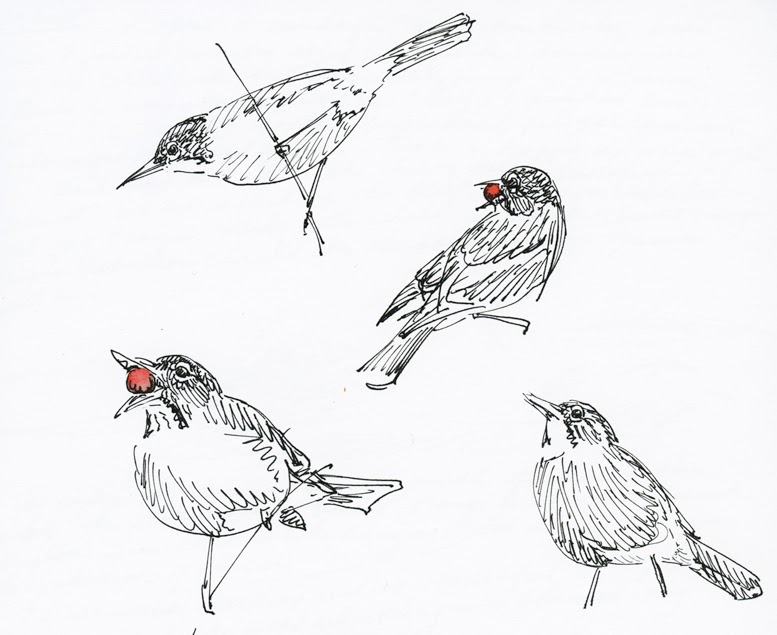
Meanwhile I’ve got a second circus going on outside the same window.  We have a volunteer English hawthorn tree growing about six feet from the window.  It is a foggy, still morning, very still; yet the hawthorn is a quiver.  Robins have arrived.  I’m always fascinated at how my hawthorn berries are ignored day after day, and then comes the invasion.  I predict that in three days there will be few berries left.  

The robins reach out, stretch out, tip upside down, even flutter to grab another berry.  I try counting how many berries one robin eats. Often I get to three, once one stayed put while he ate five!  How can he stuff in so many?  Dr. Oz wouldn’t approve of such gluttony.  

The robins feed for a few minutes.  I don’t know how many there are -- ten?  twenty?  I’d spook them if I go outside for a better view.  The flock comes and goes for over an hour, giving me a wonderful chance to draw.  I even have one cedar waxwing, but he only comes once.  I see a ruby-crowned kinglet and some juncoes too, but the berries are way too big for them.  Some berries are too big for the robins.  Often I see one get flicked aside, and sometimes a robin struggles before swallowing.  

It is 10:30 AM before life returns to a quiet normal.  I look forward to tomorrow.  The robins will be having their Thanksgiving dinner outside my window.  

Followup:  The robins did come for dinner on Thanksgiving and there were still a few berries the following day.  But today the tree is stripped and my yard is back to normal.  Earlier in the fall we had a similar invasion when the robins decided our Concord grapes were ready.  If I’m prompt I can harvest all the grapes I want before their arrival.  Fortunately I have a great plenty of grapes so the robins always have a feast.

Sunday, November 24, 2013

Eagle Encounters

Shell Island, Oregon coast, USA

Shell Island is a small island close to the mainland.  We often go to an overlook on the mainland to watch a wide variety of marine life on and near Shell Island.
Harbor seals resting on the rocks at Shell Island
Dreary.  Heavy fog above Roseburg.  When the weatherman say ‘sunny’ we take it with a grain of salt.  All too often with a large dose of fog.  We were forty miles from Roseburg, half way to the coast, before the sun came out. 

Now, at Shell Island overlook, the sky above is blue, the air cool, and just a slight breeze.  Clouds to the north speak of tomorrow’s prediction for 100% chance of rain. 

The tide has been on its way out for nearly five hours so Shell Island’s beach is well exposed.  The lowering tide has exposed acres of rock emerging from the cold Pacific waters.  Kelp bobs on the water’s surface.  The barking of hundreds of male sea lions mixes with gentle breakers rolling ashore.  Much harder to hear, I also detect the the deep growl of Stellar’s sea lions.  Silvery harbor seals rest on small clusters of rocks.

Suddenly a bald eagle zooms beneath us.  The eagle carries a Canada goose, clutching it by just one wing!  The goose is very much alive.  

The eagle is headed in the direction of Shell Island, but instead of flying over the rather wide expanse of water, it lands on the rocks beneath us.  A gull follows close behind and almost bops the eagle.  More gulls arrive.  The eagle lets go of the goose which quickly scrambles into a rock crevice. Lucky goose!  Even goose’s wing appears to be intact.  

The eagle takes off, heading to Shell Island without his goose.  Did the gulls chase him off?  Did the goose have too much fight left?  We suspect the goose was too heavy and too strong.


The eagle lands on a tall boulder near Shell Island and calls.  His head and tail sparkle white in the sunshine.  He waits.  We wait.  The goose peeks out of the crevice and then tucks its head out of sight again.  We wonder if the eagle will make another try at the goose.  
Before long a second mature bald eagle joins the first.  They perch together and chitter their silly eagle chatter.  Eagle singing sounds way too delicate to come from such a magnificent bird.  Most days the wind would whip their song away, but today we can hear it above the mellow waves.  

The eagles are after something, but not the goose.  They take turns stooping over frequent splashes just off the edge of Shell Island’s rocks.  

Success!  With an extra big splash one of the eagles lifts off the surface of the water carrying a wiggling bundle.  At first I think he has a large fish, but no.  The eagle clutches a western grebe.  The second eagle zooms in close; then veers off and perches.  The eagle with the grebe lands on a boulder and begins plucking.  Soon it looks as if someone cut open a down pillow and let the breeze float feathers away.  When there can’t be many feathers left on the grebe, the eagle picks up and flies to a different boulder, perhaps to eat his prey without a mouthful of feathers.  The eagle feeds for about 45 minutes, then joins the first.  A raven inspects the scraps left behind.

The pair of eagle perch next to each other.  Sun is low, now glowing gold on their white heads.  

BACK TO SHELL ISLAND:  Nov 8, 2013 

A week later we return to Shell Island, hoping for another eagle encounter.  It is a very different day. One eagle present much of the 3 or 4 hours we stay, but it doesn’t hunt.  At least it is warm enough for me to draw and quiet enough for me to have time to sketch without interruptions.  
There is a roar in my ears that only the loudest sea lions can penetrate.  Big waves roll in from the Pacific and crash on Shell Island’s outer reef.  White plumes burst high into the sky.  A long string of pelicans fly low over choppy waves.  If the swells were a little deeper, the pelicans would disappear in and out of their troughs.  A handful of sea lions are doing their best to stay on a small rock.  They have stretches of quiet that last a minute or two, then another big breaker slams into their little island.  Most temporarily disappear into a roil of white.

High tide turns about now.  Shell Island’s beach is only large enough to hold 100 sea lions and a handful of small elephant seals.  Clusters of displaced sea lions laze about, clustered together in the choppy water.  Each has one fin in the air.  If I didn’t know better I might assume sharks had arrived.  

End of daylight fast approaches.  A golden sun, half buried in fog, glows just above the horizon.  Tall plumes of waves cast a whisper of gold.  Every few minutes another flock of brown pelicans strokes past, all heading south.  Still just a dab  of beach for the sea lions -- constant barking and jostling.  The harbor seals have given up on laying claim to any land hours ago.  Three bob beneath me, bottling.  Noes in the air, the three will just laze until beach becomes available.  One by one they briefly disappear into each breaker as it rolls in.  

The bald eagle flew back to Shell Island about an hour before sunset.  It put a swirling mass of birds into the sky -- gulls, cormorants, even the oystercatchers.  Only a great blue heron stayed put.  The eagle doesn’t appear interested in hunting.

Burr.  It’s damp, chilly and breezy.  I have to admit I’m glad we’re heading home and not camping tonight.  My fingers hardly hold my pen.

Thursday, November 7, 2013

Klamath Basin Sketches: October 2013

My last post, “Star Gazing” was triggered by our three night camping trip to Lava Beds National Monument.  While there we spent some time in the high desert and some time on the nearby Klamath Basin National Wildlife Refuges.  I keep trying to find time to post that part of the trip too.  


While ‘in the Basin’ I did less writing than usual, partly because ‘events’ didn’t unfold.  There is a positive side to not having a lot of exciting things happen:  I had more time than usual to sketch.  Just being in the Basin is food for my soul.  Thousands of acres streatch flat.  Before white man drained huge sections of it it was a fabulous place for wildlife and the Modoc Indians.  Some has been saved for wildlife, so it still is a treasure, if a reduced treasure.  
Ring-billed Gull

Eared grebe
This post will be simple -- some of my sketches done while down there and shortly after I got home.  The great blue heron, ring-billed gull and eared grebe are examples of work done after we got home.  I often come home fired up to paint or draw some of our sighting that we have just photographed.
Friday AM -- I’m siting by myself at the corner of the big sump -- near the ‘tear drop crevice.’  At first I sketched a juniper and the half moon.  The birds all left when I sat down.  Gradually they’ve come back. Half a dozen ruddy ducks feed near me; a western grebe comes very close; farther off a grebe chick begs for food; another grebe sleeps ... eared grebes, pied-billed grebes, a few gulls.  Up on Sheepy Ridge I hear several robins.  It is one of those times I wish I could encapsulate and save for whenever I need a good dose of Klamath.

A juniper and the moon way up along the ridge-line of Sheepy Ridge.


We parked for a long time along the edge of Tule Lake.  Dale photographed and I sketched.  I always feel sorry for western grebe and Clark’s grebe parents ( two very similar grebes).  The youngsters of other grebe species all seem to be independent, but these grebe chicks yammer on.  The incessant begging reminds me of the incessant horse flies that once pestered me on a canoe trip.  We were taking my mother down a rather small stream in Wisconsin, the Yellow River.  Fortunately it was a warm summer day because once we had committed to the journey we ran into way more obstructions in the shallow stream that we had anticipated.  Over and over again Dale and I jumped out of the canoe to wade and guide the canoe over, under, or around a log.  The horseflies were simply awful.  I still remember taking a deep breath and going underwater for as long as I could hold my breath .......  ah, relief!  I can’t help but wonder if these grebe parents don’t feel a little of the same relief when they escape their grebe chicks by going underwater.  


I confess I peeked at the back of the camera when I sketched the adult handing the minnow to its chick.  The back of a digital camera can me a handy tool when field sketching.  Just a quick peek at a still subject is so much easier than the quick glimpse when it actually happens.  
A few open grown willow trees grow in the strip of land between Sheepy Ridge and Tule Lake.  We know to look carefully and, with luck, we’ll spot a great horned owl roosting in the willows.  I penciled this guy on location, but did a lot of the inking while we waited for grebes and at home. 

We spotted one really nice mule deer buck.  He whetted our appetite for returning to the Basin during the rut -- which would be right about now.  Unfortunately the weather will keep us home instead.  

Sunday, October 27, 2013

Star Gazing

Lava Beds National Monument, California, USA

This post is mostly about current events, but I’ll start with a clear morning over twenty years ago.  Dale and I were canoeing on Tokatee Reservoir, Oregon, fishing brown trout.  I cast my grasshopper over the clear, cold water and was startled to see a searing white light cut through the sky and disappear behind the nearby mountain.  What was that!  

Later, back at Dale’s office I described my sighting to his Forest Service office mates.  The sighting was very close to the Fourth of July, and promptly dismissed as someone’s fancy fireworks.  I didn’t buy that explanation.  Fortunately I didn’t have to.  I soon learned a meteorite had fallen into the Cascades Mountains.  I wasn’t the only person to have seen it.  

Now, fast forward to last Tuesday night.  This time it was pitch dark. Dale and I had already reached Lava Beds National Monument and were about 5 miles from camp.  Wow!  A blaze of bright tore through the sky and fell behind the nearest ridge -- way brighter than any shooting star.  It seemed as bright as the meteorite I’d seen years ago, but I assume the dark sky was misleading.  I couldn’t help but wonder if it was another meteorite, but I would have to wait until we got home to find out more.

We camped three nights.  Lava Beds is the best place I know to peer far, far into the heavens.  The monument is a treasure of sage, bunch grasses, juniper, and lava tucked at a relatively high elevation and far from any ranch lights.  The moon was well past full and rising after total darkness.  In those few hours between total darkness and moonrise, the Milky Way stretches above -- a faint avenue of brightness caused by zillions of stars.  When I gaze into those depths I feel I’m part of the Universe, not just a spot on Earth.  I never see that clear, crisp sky when I am in town or in most places for that matter.  
While at Lava Beds I pay extra attention to the stars above.  We saw several shooting stars while snuggled in our sleeping bag.  I noticed the top of the big dipper was parallel with earth when darkness fell and just starting to tip when we went to bed.  I always make an outhouse run in the middle of the night.  Part of the run is checking on where the big dipper is.  Has it tipped far enough to tell me I probably won’t have to get up again during the night, or is it traveling all too slowly as it pivots around the North Star?  I know by morning it will have rotated a little more than 120 degrees (Each day it rotates full circle, 360 degrees; so it’ll move about 120 degrees during my night).  

Once home I checked the internet to see if there was any news of a meteorite falling --  No.  But I did learn we had camped during the Orionids meteor shower -- a time when earth passes through debris left by Halley’s Comet.  This happens twice a year!  It has been a good year with lots of ‘fireballs’ sighted.  When the meteoroids enter earth’s atmosphere, 30 to 80 miles above ground, the friction of their intense speed literally burns them.  Most are destroyed in the process, but a few meteorites survive and hit the ground.  

Did I see another meteorite?  I don’t know.  It wouldn’t surprise me if a little dab of outer space now lies in the Medicine Lake area if northern California.  Its an unpopulated area.  Perhaps we were the only ones to see it fall.  

If anyone is interested in learning more about meteor showers, there is a wealth of information on the web.  Each year we have half a dozen showers of significance.  A lot of ‘shooting stars’ and small and far away.  The closer ones, ones that blaze as they enter our atmosphere are often referred to as ‘fireballs.’  Each one is named for a constellation in the sky and that gives a clue as to where to look. If you plan to go star gazing be sure to check on the phase of the moon.  Even just a half moon in the sky at Lava Beds means we see far fewer stars in the sky.


Monday, October 14, 2013

Lulu, Daisy Mae, and Darth Vader


Cris, a friend of my just lost a pet chicken, Suzi ... the little hen that never was quite healthy and died before she was a year old.  Fortunately Cris has four others, all best buddies and a big joy in her life.  Not only do I get to enjoy the chickens on her blog ( http://anartistscountrylife.blogspot.com ), but I have even visited them.  

Right now I ache for Cris.  I also have been very attached to a pet chicken.  Actually I had a series of pet chickens when I was a little girl.  Cris’s loss has brought back fond memories of my pets.  

The first was a white leghorn, Lulu.  By the time I realized Lulu was a dashing rooster it was too late to change his name.  He didn’t mind.  He was very self assured.  Remember that Johnny Cash song where the guy is named “Sue?”  Well, the guy named Sue turned out just fine and so did my Lulu.  

I was too young to know the consequences of having just one chicken during a Wisconsin winter.  Poor Lulu froze the tips of his toes off.  Even that didn’t bother him.  He fluffed and strutted and crowed.  It was the crowing that ended my wonderful time with Lulu.  At home in rural Wisconsin the crowing was a joy to wake up to, but I was allowed to take Lulu when I went to visit my grandmother for the summer -- in a residential community outside Boston.  Crowing definitely was not on the agenda!  Poor Lulu was given to a chicken farm.  I had no choice.  I was just a little girl.  I can still see the farm.  Hundreds of white chickens pecking about and long low sheds for egg laying.  I had no choice in the decision but it seemed all right.  I wonder how he managed with all those ladies? 

Daisey Mae in Her Chicken House

Next spring I had another chick, this time a little red one, a New Hampshire Red.  Daisy Mae was a doll.  She soon grew into a handful of fat, egg-laying joy.  She rode the handle bars of my bicycle and laid her eggs in a box in our outhouse.  We tried other spots but she knew what she wanted.  I know she liked grabbing the tail of toilet paper that hung down and would run with it until the paper tore.  My father always sputtered, reminded us not to leave a tail hanging, and put up with this nonsense.  Meanwhile my mother made sure Daisy Mae wasn’t going to freeze her toes off.  She built a tiny double walled, insulated, chicken house complete with a window and a solid door.  At most the chicken house could have held three small chickens or two big ones.  I could reach in and feel that Daisy Mae’s body heat was warming the interior.  When it got bitter cold, we could put a light in there for warmth.  At sunset the door was closed, and the first person heading out to the outhouse in the morning opened the door.  

All went well until I read a paragraph in “Ripley’s Believe It Or Not” about a chicken that could swim.  Could Daisy Mae swim?  I often kicked about in an inner tube with her on my lap, but I never put her in the water.  Remember ...... I’m only about ten years ago and no one is paying attention to what I’m doing.  I put Daisy into the water, just for a moment.  Immediately I knew she wasn’t going to make it into Ripley’s, but the damage was done.  A few days later my dear Daisy died of pneumonia.  I was devastated.  Not only had I lost my pet, but I was responsible.  

My next chicken was too old when I got it -- probably just two or three weeks.  Nina was a pretty bantam hen, but she didn’t tame down.  She happily pecked about the yard and always knocked on the kitchen window when she wanted to lay an egg.  Her choice of place for egg laying was a Quaker basket in the living room.  Nina would go straight to the basket, make a big fuss over the small plastic jar of Elmer’s Glue in the basket, and then sit tight until the egg was laid.  But she wasn’t a pet ..... so off to a farm she went.  

My fourth, and last chicken was a disaster.  As usual we didn’t know the sex the little chick, but I named it Pinocchio.  He should have been named Darth Vader or the Terminator.  I only had my chick a few days when I was shipped off to my grandmother again -- without Pinocchio.  My parents assured me they would take good care of Pinocchio.  They did.  He had plenty of food and safe harbor, but no bike rides, inner-tube swims, and never got dressed up in doll cloths.  By the time I came home in the fall he was an aggressive monster with spurs an inch long.  One of our dear friends was attacked when she got out of her car.  Ruth had to have stitches to mend her leg.  Needles to say, Pinocchio got farmed out to another farm.  But this time I didn’t mind.  Pinocchio and I never had enough time together to bond.  

My chicken days were over, but I had learned several important lessons, the most important being they can be wonderful pets, but they need lots of care and attention to include humans in their flock.  I look back fondly at the time when I was a member of a chicken family.